Showing posts with label telecom. Show all posts

Monday, September 25, 2017

#HurricaneMaria hits Guadeloupe,US Virgin islands, Puerto Rico, Dominica

Dear reader,

just as hurricanes Harvey and Irma left Texas & some parts of the Caribbean in  ruins, another hurricane - Maria - wreaked havoc in some parts of the Caribbean which haven't been punished that much a few days.

Regarding communications and electricity supply at least two islands - St. Croix and Puerto Rico - have been hit by Maria. Although the hurricane went through an eyewall replacement circle just before hitting Puerto Rico with "just" category 4, St. Croix was hit when it still was a category 5 storm. The effects on the islands' infrastructure was quite similar - In Puerto Rico according to initial reports from various sources 100% loss of the power grid & a 95% loss of cell towers for mobile phone voice and data connections.

Ricardo Rossello, and officials still had not had communication with nine of 78 municipalities.
"This is a major disaster," he said. "We've had extensive damage. This is going to take some time."


Besides the loss of electricity the subsidiary of the US National Weather Service lost its radar, which was also blown off its mast. The island which has about 3.5 million inhabitants is plunged almost completely into darkness and the fresh water supply is also affected. Many hospitals have been rendered useless, because of destruction or because vital supplies needed for running a hospital can't get delivered. Officials from Puerto Rico indicated that the electricity situation could last the next 4-6 months.

Roads access to many places has been restored, but gasoline & diesel (¹) is rationed and this affects also the generator operations resulting in frequent loss of local communications which could be restored. From US Virgin Islands reports are being picked up, which seem to suggest that cell towers running on generators are forced off the air because the generators are getting stolen.

People from outside Puerto Rico e.g. from the US mainland are desperately trying to get in touch with their relatives and because the Internet is also heavily affected the usual helpful tools like people finders by e.g. the Red Cross or by Google can't be used.

The most catastrophic scenario regarding communications and electricity has happened including "back to the basics" which is in this case to rely on ham radio operators and their shortwave transceivers. Initial reports however suggest that some operators also have problems with their generators, since gas stations are far away and are only supplying private citizens with a few liters of gasoline or diesel fuel.

Contrary to the earthquake event which occurred in Mexico and which claimed so far 300+ lives, the loss of life - at least as of known today- is fortunately low. Since the measures to restore communication and electricity have been described here just a few days ago (regarding hurricane Irma) this blog post will show some damage inflicted on transmission towers, cell towers, antennas, dishes, electricity poles, sub-station, transformers, etc. There will be also some tweets on the fuel scarcity currently in Puerto Rico, which impacts also the use of generators.

Some photos will be added in the upcoming hours as well as some indications of some backup communications already implemented. (by the military and radio amateurs)

Stay tuned ...

Impact on communication & electricity infrastructure 
(various islands, various sources,tweets currently unsorted)


So it's fair to conclude that all structures carrying cables or antennas have failed on those islands subjected to cat4/5 hurricane winds. Estimates during hurricane Irma's period of being a category 5 storm: approximately as devastating as a F3-F4 tornado ! All masts and poles, not just the (local) wooden ones, have been either totally destroyed (complete structural failure/collapse) or did at least bent enough to allow cables to break. It's also fair to assume that no tests were conducted on all those types of masts and utility poles and the ones used were just "normal" ones which can used in 'dead calm areas'. From own experience with antenna masts and attached UHF/VHF aerials it can be concluded that the torque what impacts the bending moment of the mast is often underestimated. Attached items like antennas or cables and insulators produce additional stress (wind load) to certain points of the structure and forcing the material to either bend or break.

Since antennas for either cell services or TV and radio broadcasts have to be installed on a elevated position those masts have to be considerably stronger than ones currently in use (or destroyed on those affected islands). Wooden structures have been blown to pieces (also roofs and trees) so this material can be deemed not strong enough to withstand 250-300 km/h winds. Masts made of steel or concrete must get reinforced, perhaps by adding additional materials or by simply enhancing the thickness/density of the materials used. The manufacture's guidelines for additional attachments to this structure must also be followed by those telecom firms which use them. If it turns after testing that those structures can't be made strong enough to withstand such winds, at least oblige those firms to have sufficient spare parts in place to restore services withing hours or days, not weeks or months ! 

Electricity cables however are installed above the ground because it's cheaper, not because it's technically impossible to implement other solutions. Serious questions have to be asked why many countries in Europe, which don't even suffer from such kind of destructive winds, are used to lay cables in the ground. It's not only possible for rather low voltage lines which are directly connected to people's homes, but also highest voltage cables for underground or seabed installation are available. Of course it's more work and more expensive to have them installed beneath the earth's surface, but in such hurricane prone areas the damage to public and private property and even the risk of costing lives is too high. Utilities have to be forced to overhaul their entire network within a reasonable time frame, not only including underground cables, but also 'circuit breakers' like large capacity battery systems at least nearby buildings with extreme importance for upholding public safety.
 
failing power & communication infrastructure during previous tropical cyclones:
Power out in parts of Yolanda-hit Tacloban City [PHL, GMA news, Dec 28 2013]
Leyte and Samar islands still without power days after Yolanda super typhoon [PHL, GMA news, Nov 13 2013]

related reading:
(please note: EZR endorses this message in general, but not necessarily the use of (certain) words) 

Wednesday, September 13, 2017

Listen to the radio - the emergency broadcasting network

future blog post regarding the significance of getting vital information to people in a vast disaster zone when all other forms of modern electronic communication are down.

As usual with some historic perspective on the one hand and an outlook regarding the use in future mass casualty events.

Radio is simple to use, effective way of getting instructions to those who are otherwise left clueless or, even worse, dependent on the spread of rumors in absence of real, verified and reliable information.

Unfortunately many broadcasting capabilities of stations using airwaves with very long ranges like shortwave have been reduced, because nowadays other broadcasts and Internet based transmissions of sound, video and text are more popular and (admittedly) of better quality. The only problem is what to do if these more modern forms of telecommunication fail ?


source: Youtube, uploaded by RogueStudio TV

A visual severe weather warning makes sense to alert people when they just watch TV and must get the severe weather warning as soon as possible in order to get the maximum time to prepare themselves for the impact of that weather emergency. As described many times: there are dangers like earthquakes which can't be predicted when they happen and if they happen only a few seconds (up to very few minutes far away from the epicenter) forewarning time remains.

When a disaster has impacted the populated area and all those TV/radio transmitters, cell towers, satellite connections and land lines for phone or Internet have been damaged or destroyed the population has suddenly no reliable source of information. The first simple, but sufficient thing to restore is radio ! It doesn't require as much technical stuff as TV and its signal could be picked up over a much wider area than TV. Many people do have TVs, but what if they all don't have AC power ? Many people however do have portable radios which also run on batteries, many mobile phones have built-in FM receivers (many owners might not be aware of this feature) and most cars have a radio which offer at least FM reception, sometimes even AM bands and cars/trucks have fully charged 12/24V batteries which could last for days if just the radio is switched on. (of course the battery also recharges if the motor runs)

To setup a backup FM/AM transmitter doesn't require that much financial and power resources and the advantage in holiday destinations abroad is that there's no worry about all those different TV standards in all those countries. (NTSC,PAL,SECAM,DVB-T,DVB-T2,how many lines, 50 or 60Hz, etc)

FM is FM and AM is AM all over the world, just there might be some countries which have slightly different frequency bands. It's also much simpler to get a 'network' running, since only one powerful transmitter is need in order to reach possibly millions of people (in densely populated areas) instead of numerous cell towers for 3G/4G or WIFI networks. Radio has noticeably the disadvantage of offering no channel from the citizens back to sender, but in time of regional/national/international crisis it's more important to get instructions out for the population.

As currently ongoing 'crisis light' (it could have been much worse, with many more dead and wounded) reminds us that often such simple things like where to pick up food or water at an outlet run by either military or NGO wouldn't be possible without radio instructions or printed fliers. (recently the Dutch Navy hand the latter out at Sint Maarten) Food and water distribution points are important and so are instructions for evacuation, medical tips or tips on hygiene or where wounded can be brought to in order to get proper treatment. It's hard to imagine for millennials, but for more than 50 years the world managed pretty well without Internet, apps, Youtube and all the other nice gadgets. Those gadgets are nice to have, but pretty useless when there's no Internet via 3G,4G,WIFI,Cable or DSL which can be knocked out all at once.
Radio can also be pretty upsetting for those who are used to comment on each and every message they come across. Radio is pretty simple: We (radio operators) talk, you - listen ! In an emergency that all what counts. It's like "Do this - or you might die"


Emergency broadcasts in Sint Maarten/Saint Martin (Hurricane Irma)

Florida (Hurricane Irma)


[Update Sep 26 2017 (Hurricane Maria)]

Puerto Rico has lost almost all (95%) communication infrastructure, and while FEMA is publishing 'rumor control' info on its webpage, it's highly unlikely that people in Puerto Rico are able to read it, since most of them currently don't have Internet access !
Even the local subsidiary of the NWS was hit hard by hurricane Maria and according to latest info available from officials, there's stil no contact with 7 areas of Puerto Rico. No power, transmission systems are down, fuels are rationed. The governor and other officials rely on local AM/FM stations to get their word out to the people. There will some updates here shortly - stay tuned.
[/update]


Broadcasting equipment
Broadcast 500W and 1KW FM Transmitters [commercial] #

related links:
Emergency Broadcast System (USA) [Wikipedia]
Emergency Alert System (USA) [Wikipedia]
Emergency Alert System (EAS) (USA) [FCC]

Saturday, September 9, 2017

Communications during/after a catastrophic event

Dear reader,

hurricane Irma has just wreaked havoc on several nations & small islands in the Caribbean area of our planet and some of those islands have not only lost numerous, if not almost all buildings, but also their ability to communicate with the outside world.

This not only hampers the rescue & relief efforts since no clear picture of the disaster can be obtained by voice or written reports or simply some photographs/videos being taken and transmitted to those who can deliver help, but also leaves confusion and room for dangerous rumors. If no 'proper' flow of information can be upheld people inside and outside a disaster area tend to spread rumors or 'hearsay info' which can result in panic or looting or violence.

In order to uphold proper communication channels basically two things are required: electricity and communication equipment with all 'attached stuff' like fully operational antennas or cables connected a network/grid.

Electricity is usually distributed via power lines, which are often prone to get destroyed if they rely on poles rather than on underground cables. Even when the entire electricity grid consists of underground cables, there must be some inter-connectors and substations in the system which could easily be affected by flooding or metallic debris flying around by strong wind. A blackout of the entire system or only some parts of the AC power grid also affects all kinds of communications from landlines to GSM & other wireless networks to HF/VHF/UHF transceivers and satellite comms equipment.

When the regular power grid is down it might take days, weeks or even months to repair it because spare parts are often available from local stocks only in limited quantities. Everything from miles of cables, wooden or concrete poles, insulators, entire substations, etc must be ordered from one or more manufacturers and then there's often the problem of damaged or destroyed roads/airports/ports which makes purchasing new vital equipment a challenge.

So very often it is better for individuals/firms/authorities to rely on DC backup systems or on a 'private', small scale AC network powered by diesel/generators or by a or solar 'island solution'(offgrid) consisting of solar panels, batteries and (DC>AC) inverters. With the help of a BESS system connected to a part of the regular power grid or even the entire grid, an AC system can be powered up again with some solar and/or wind generators instead of power stations running on conventional fuels. However this medium range solutions will also take some time to fire up, since the damaged grid can require multiple replacements or repairs. 

According to Dutch minister Plasterk the situation on St. Maarten is momentarily rather bleak concerning electricity & telecommunication:
translation: There has to happen a whole lot on St. Maarten, communication
with the island is still difficult, says minister Plasterk,

  # Please note that all links marked "commercial" provided in this blog post are only to demonstrate that all mentioned products or methods are readily available. Of course there are many other similar products on offer by competitors and all hardware mentioned here isn't a "must buy" recommendation. So everyone interested in such products should do proper market research.  

Offgrid solutions, small & medium sized
Local 'private' solutions are easier to transport and to fire up, but relying on liquid fuels like gasoline or diesel might also be a problem in a disaster zone where gas stations are either sold out or destroyed. The fuel distribution system needs to be intact in order to produce electricity locally or small scale wind/solar generators have to be used in order to be independent from properly working fuel distribution system. In can even be most cost effective in the long run and it's safer because the improper use of fuel powered generators pose a risk of carbon monoxide poisoning. There have been disasters in the past where people either didn't heed the warning of authorities not to use generators inside buildings or didn't read the instruction manuals or both.
Carbon Monoxide Deaths: Generators Cause At Least Nine Fatal Poisonings After Hurricane Sandy [Huffingtington Post, Nov 2 2012]
Besides the CO problem conventional generators produce noise & need maintenance (lubricants/spare parts/service personnel) just like any car/truck. During maintenance a second backup generator has to be used or there is 'planned blackout'. Solar systems don't need much (or no) maintenance but wind generators do, albeit much less than combustion engines.

commercial storage hardware
size: ¹=small,²=medium,³=big
All-in-one solar power solution [Victron] ¹ #
Stand-Alone Solar Solutions [SMA] ¹/² #
Y cube - unsere plug-and-play Energiespeicherlösung [Younicos,pdf 6 pages,German] ²/³ #
Y cube - plug-and-play energy storage solution [Younicos,pdf 6 pages,English] ²/³ #

Powerwall [commercial,14kWh] ¹ #
Tesla Powerwall [Wikipedia] ¹ #
10 home batteries that rival Tesla’s Powerwall 2 [Business Insider, May 18th 2017] ¹ #

Solar/Wind info
Solar yield calculator  [EU Commission, 4 Europe,Africa,Asia]
RE Explorer [NREL]
Solar Maps [NREL]
Wind hybrid power systems [Wikipedia]

Extra strong solar panel (4000 instead of usual 2400 Pascal wind pressure)[commercial] ¹/²/³ #
approx 10KWpeak (53 pcs) =795kg,& 67,7 square meters (installed) 

Offgrid solutions, micro size
8 best solar chargers [The Independent, Apr 13 2016]
10 ways to make your phone's battery last longer [CNET, Aug 26th 2017]

Offgrid cooling*
(12/24V DC = more efficient than 230/110V AC systems)
Welcome to Waeco Fridges UK [commercial] #

* think about cooling for medical purposes first and then there's the general need for refrigeration of perishable food. 

Renewable goals, energy prices and economics
(before Hurricane Irma struck the island & outlook) 
(this section is currently under construction)

Energy Snapshot Saint Martin/Sint Maarten [NREL, pdf 5 pages,ENG]
(detailed data re. production, distribution & consumption of electricity - 2012(!))
Duur
Consumenten in St. Maarten betalen $0.35 per kWh voor elektriciteit. Curaçao en de Bahama’s zijn het duurst in het Caribisch gebied met $0.42 en Suriname, dat hydro-elektrische installaties gebruikt, het goedkoopst met $0.05 tot $0.11 per kWh.
translation: Expensive. Consumers in St. Martin pay $0.35 per kWh for electricity. Curacao and the Bahamas are with $0.42 the most expensive in the Caribbean area, and Suriname which uses hydro-electric generators is cheapest with $0.05 - $0.11 per kWh 
source:St. Maarten publiceert ambitieus energiebeleid [Caribisch Netwerk, Sep 5th 2014]
Duurzame en betaalbare energie in Caribisch Nederland [rijksoverheid.nl,pdf 18 pages, Dutch] (Just for islands of Saba, Sint Eustatius & Bonaire)

Landlines
advantage:
does not need power at client side, although many customers use base stations & wireless units, which don't work without electricity.Keeping old fashioned telephones for emergency use recommended
disadvantage:
poles with phone lines can be damaged by storms, switchboards can also suffer from wide spread power outages or can be affected by flooding or wind damage.

HF transmitting equipment 
advantage:
Can be used to establish long distance connections (up to thousands of miles/kilometers) in different operation modes (CW/morse code, voice or data), does not need to depend on sophisticated existing networks. Can be used mobile/portable.
works like a radio broadcast, multiple receiving stations can pickup message

disadvantage:
Depends on atmospheric conditions (daytime/nighttime & solar winds),
good antenna
Outside world must monitor the used frequencies/operating modes
signal reception often varies
often legal restrictions apply in various countries
high power consumption for transmitting energy (depending on output)

Phone Patch, Autopatch and HF/VHF/UHF Operating Guidelines [re.:USA,ARRL]

VHF/UHF transceivers
Usual range ca. 0-200 km
advantage:
usually more stable connections than much lower HF frequencies, higher data rates / better voice quality are possible because of more available bandwidth

does not need to depend on sophisticated existing networks. Can be used mobile/portable.
works like a radio broadcast, multiple receiving stations can pickup message


disadvantage:
For maximum range high-gain antennas are needed which sometimes are difficult to use in urban areas. Another problem are mountains/valleys which can block propagation of airwaves as well as large buildings.
in some countries legal restrictions can apply
high power consumption for transmitting energy (depending on output)

Satellite based communication
advantage:
depending on system operator could work on the entire planet
stable high speed/data rate connections
quick & easy to setup communication
works without existing infrastructure and could substitute broken systems
ideal as backup after destruction of regular lines of communication

disadvantage:
depending of frequency bands used can be affected by tropical rain downpours
Antennas (dishes, flat square) might not work in buildings, densely populated areas - mostly need free line of sight from client unit to orbiting satellite
expensive (hardware & operating costs)
in some countries legal restrictions apply


HF transceivers (commercial website)

Satellite based communication
VSAT systems [Wiki]
VSAT coverage maps & FAQs [commercial website]
BGAN systems [Wiki]
SNG & Microwave Systems [Wiki re video & audio broadcasts]

Satellite backbone & small GSM network [&WIFI=preferred technology]
GSM Rural Extension | Site Installation [commercial website] #

Rural Mobile Telephony: A VSAT (Satellite) based Approach
[by F.E. Idachaba & F.O. Edeko,pdf,Covenant University & University of Benin]


AT&T GSM Microcell [commercial, pdf file 12 pages] #

Iridium system
multiple phone lines [commercial website, French] #
various Iridium phones [Iridium] #

all kinds of SATphones [commercial website,UK] #

US National Guard's Hurricane Irma response
"The JISCC is specifically tailored to support unique homeland defense and civil support mission requirements," said Maj. Michael Holton, commander of the 233rd Space Communications Squadron. "It provides non-secure voice, data, video, intra-team radio, and radio interoperability for first responders supporting the incident commander."
source: Colorado National Guard sending special communications facility and crew to South [Nationalguard.mil Sept 10th 2017] 

If Internet access is still available, saves network capacity:
Hurricane Sandy - Emergency communication setup using Twitter
[EZR,Nov 2 2012]

Preparation 
The impact of a catastrophic event on communication infrastructure can be very limited if:
A existing technology is more resilient (strengthened/reinforced) and has a backup system which could ideally be fired up within minutes or installed in a matter of hours.Countries can force the private sector to invest in resilience by granting/renewing network operating licences only when all requirements are met. Requirements should include wind/rain/flooding/shaking scenarios and consider all possible 'Achilles heels' including installing backup power facilities high enough above ground to avoid flooding.
>>The pre-event tsunami hazards study, if done properly, would have identified the diesel generators as the linchpin of a future disaster. Fukushima Daiichi was a sitting duck waiting to be flooded.”<<
         source: Fukushima disaster was preventable, new study finds 
        [Robert Perkins,University of Southern California]  

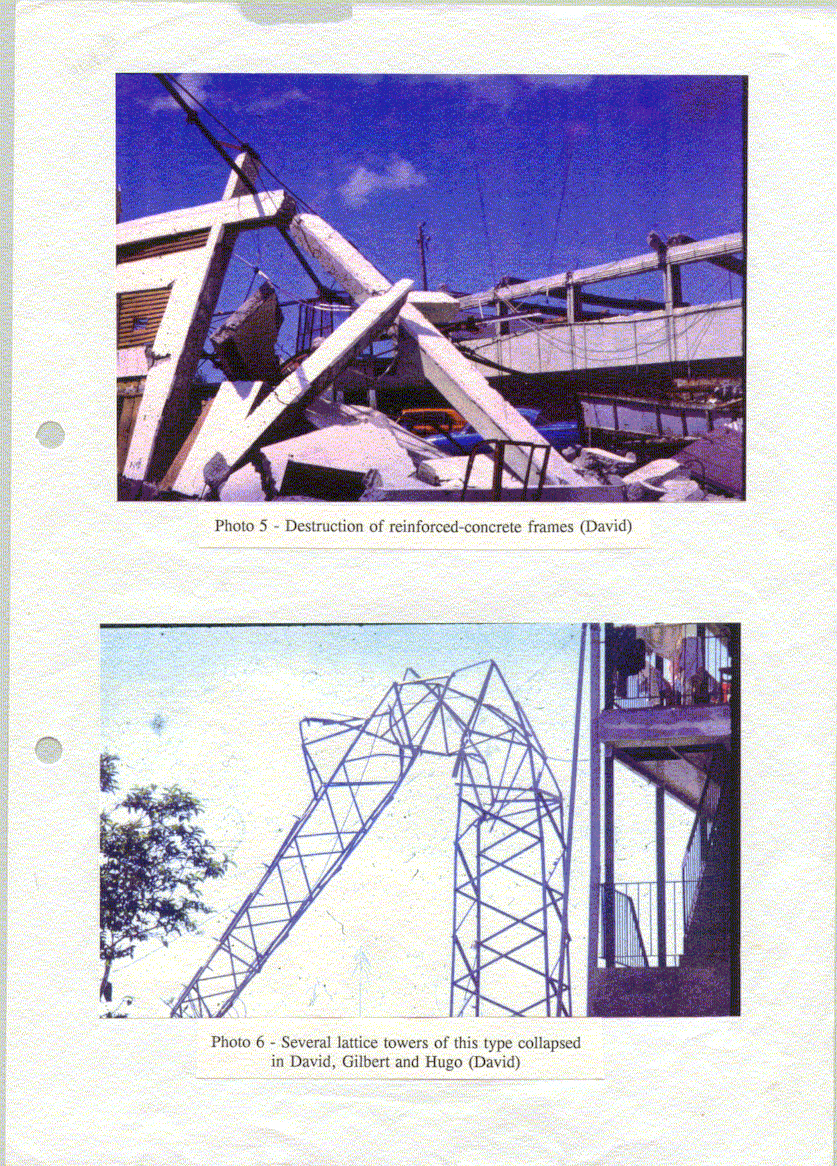
Regarding structural failures of TV/Radio/Cell towers this was found ::

2.2.6 Telecommunication Towers and Masts (Photo 6)


These are almost always consciously-engineered structures. There is no good reason why so many of them fail in hurricanes. The bad reason is usually inadequate procurement procedures. Specialist advice is not often sought in specifying design criteria for suppliers or in checking that specified criteria have been met. The most common destruction of engineered structures in Caribbean hurricanes is in this class of facility.


source: Hurricanes and their Effects on Buildings and Structures in the Caribbean [by Tony Gibbs, Director, CEP, oas,org]

So this section on towers and masts suggest that in principle a design withstanding even the highest wind speeds would be possible to implement on those regions, but so far not too many firms/people/authorities cared about this resilience. Some SHF antennas (parabolic, offset or other designs) used for long distance connection either for horizontal (terrestrial) point to point connections or for a satellite link up/downlink have a problem since they have a high wind drag and the materials widely used aren't not thick enough to widthstand the high torque forces. They either bend or break which on both cases renders them useless and usually they can't be repaired. Some more research has to done on satellite dishes made from solid concrete and their 'survival rates' during tropical storms. They do exist, this author has seen some of them built by ham radio operators. They used this material because of the low costs and in order to be able to cast the dish according to their own specifications (like e.g. F/D ratio). A ground mounted satellite dish made of solid concrete should be able to absorb high winds and even impacts of smaller objects without to much damage.  


Some examples of similar structures have been found: Acoustic mirror [Wikipedia]

The alternative for increasing the chances of 'dish survival' would be a protective cover. Either those giant 'golf balls' made of extremely strong reinforced plastics (because metals would block incoming/outgoing SHF signals) which could allow operation to continue even during a storm, or a metal cover, some kind of 'garage' which can house the dish safely during the storm. It would have the advantage to shield the disk also from projectile impact provided the steel or better titanium is thick enough.    

Maybe it's possible to stimulate research projects with the aim of adding or replacing materials used today for the production of lightweight and strong, but not strong enough dishes for hurricanes. 
Carbon fibre satellite transmission dishes are accurate and portable [MaterialsToday, Feb 14 2007]

Kevlar comes to mind, because it's used in modern bullet proof vests or how about adding a steel reinforced concrete layer at the back of a commercial carbon fibre satellite dish. Creativity and testing is needed.  

National authorities should demand that vital communication infrastructure should be able to survive a set of dangers that can be expected in the area such an entity will be or was constructed.
Archives and historical records should be (re)checked for clues about quantity and magnitude of such catastrophic events in the past and new regulations should be of course as stringent as the worst case found on record or what scientists of various faculties believe are possible in the future. After such a area specific analysis it would also be easier to determine what option (A or B) to pursue.   

 The New Yorker's Amy Davidson, meanwhile, recalls Haiti's recent 7.0-magnitude earthquake, which was less powerful than Japan's but decimated the country's vulnerable infrastructure and killed hundreds of thousands of people. "The scenes from Japan are awful," she writes, but comparing the disasters in Japan and Haiti provides "evidence of why earthquakes are political and economic, almost as much as natural, experiences." Buildings in Tokyo swayed, other water-drenched structures collapsed, and cities in northern Japan suffered more than the capital, Davidson writes, but Tokyo "hasn’t been flattened in anything like the way Port au Prince was."

In a sign of Tokyo's reslience, images are now surfacing of the Tokyo Tower, re-lit and relatively unscathed.
             source: Did Engineering Save Lives in the Japanese Earthquake? [The Atlantic, Mar 11 2011]


The Sky Tree's shinbashira is a hollow concrete tube housing elevators and stairs. It's structurally separate from the exterior truss but is joined by oil dampers, which help reduce quake shaking.

"The anti-quake measures in this structure can reduce quake vibrations by 50 percent," Hirotake Takanishi, PR manager for Tobu Tower Sky Tree, told me. "We've run simulations showing the Sky Tree will withstand an 8.0-magnitude earthquake, and can withstand even stronger ones, but we can't say definitely what its upper limit is."
        source: Japan builds Tokyo Sky Tree, world's tallest tower [CNET, Mar 1 2012]
or
B replacement hardware is safely stored nearby and doesn't need to be purchased from manufacturer once such an event happens. Ideally logistic experts like military has 24/7/365 access to such storage places in order to react fast enough. A storage place near a tactical airlift airport would be ideal.

Reliable Hurricane prediction gives logistics/technicians at least 3 days time in advance to predict possible impact and to plan for effective approach to restore full, or at least partial, communication ability in order to reduce additional negative impact on the local population. Runways and properly working ports are important, but so is communication for multiple reasons.

Currently and in the near future earthquakes can't be predicted in advance.

Possible improvement rapid response
current conditions Sint Maarten:
       engl.:"Situation on Sint Maarten is dire also due lack of basic needs and  
       communications. Thus in the upcoming days capacities will be increased."
       Royal Dutch Navy
 
In order to avoid a delay caused by difficult conditions at one or more airports in the disaster area in coastal areas Navy vessels equipment with state of the art satellite communication abilities should also allow an optional microwave link from shore to ship and allow a 'bridge' function of on-board comms equipment with communication equipment deployed in the disaster zone. At least communication channels under the control of own troops should be able to establish a satellite link. If 'comms teams' are deployed before e.g. a hurricane hits the designated area they could use the time between they are safe to setup their gear and the time the Navy vessels are back in range of the microwave link after they have left the theater in order to avoid being affected by high winds and/or high seas. VHF/UHF link is also a possibility, which should be easier to establish, but has less usable bandwidth. In case of current island scenario it could have worked for local officials to use an emergency GSM network (restricted by special SIM cards or by phone IMEI numbers) including a direct link to the Netherlands or France. 

Radio/TV
The full extend of damage to various Caribbean Islands is not know at this point and hurricane Jose trailing Irma has not left the area. According to preliminary reports some transmission towers not only carrying GSM cell phone signals but also those carrying radio and television signals have been knocked out by Irma and those which may have managed to survive the first blow might not endure a second beating by Jose. It should be considered to equip Navy vessels with some lower power FM transmitters for radio broadcasts and VHF/UHF transmitters for emergency TV channels usage.
Such low power transmitters (200W - a few KW) have been in use in the past at various Airforce and Army barracks where US, UK or other countries' forces have been stationed. A local population in a disaster zone with access to regular and reliable information might start to spread dangerous rumors and it is also useful to provide vital information in a time where there's a media blackout as well as a power blackout. Many locals have small radios or TV sets or at least have smart phones or tablets, but during a long lasting power blackout a free of charge distribution of e.g. simple solar chargers or the establishment of generator powered public recharging stations could be the first step to restore some control. Once the public has access to limit amounts of electricity they can use their devise to receive important messages such as planned evacuations or a constant flow of information that additional resources are being sent in. Larger Navy vessels like US carriers already have own TV studios and a CCTV system which just need to add a small transmitter.
Regarding FM radio broadcasts it's also worth remembering that not only households have radios,but there also portable radios, those in in cars, and also many modern phones have built-in FM radios (often the headphone cables serve as an antenna). Regarding broadcasts from ship to shore, there's nothing unusual about it since this was done since the 1960s by various radio pirates which circumvented national broadcast legislation
in the UK       : Radio Caroline
and in the NL : Radio Veronica

So the idea that Navy vessels should be able to broadcast in emergency situations isn't so far fetched at all. Especialy when keeping in mind that many larger population centers around the globe are near or directly located at the coast.Of course using FM band instead of long or medium wave (in AM) would make much more sense nowadays. If Navy vessels are also used for emergency assistance their role in 'rumor control' and informing  the local population (with perhaps some entertainment as well) should be made possible by adding some broadcast equipment consisting of transmitter and a rotatable Yagi antennas .  
>>Speaking at the same news conference, Dutch Interior Minister Ronald Plasterk said that some 70% of the houses on St. Maarten have collapsed. After days of major difficulties in communicating with the island, “some communication” has now been restored, he said.
Soldiers have distributed leaflets and used megaphones to tell locals to stay indoors, as Hurricane Jose is expected to pass north of the island later on Saturday. Most patients have been evacuated from the island, the minister said.<<
       source: WSJ , Sep 8 2017

Although good old leaflets are better than no information at all, they also require some logistics to get printed and distributed. It might take some investments to be able to deliver 21st Century solutions to our vacationing citizens and locals alike, but once modern communication assets are in place it sure makes getting the 'official word' out much easier & faster. Many people have sophisticated hardware to receive such messages and are perhaps even more than willing to provide feedback to authorities in order to speed up and  optimize rescue & relief efforts. Once the broken communication channels (radio/TV/GSM networks/WIFI) the citizens are familiar with are restored the mood will most likely change from 'grim' to 'a bit more relaxed'. Considering bandwidth scarcity during the initial phase, perhaps starting firing up GSM SMS messaging service and public WIFI with only a limited number of open ports for the use of messaging apps like Whatsapp, Twitter, Facebook would be sufficient. It would certainly send a positive message that the local, disaster struck society isn't warped back some fifty or more years when they have to cope without electricity and modern electronic communication for many days or even weeks.

Hurricane Irma was terrible, there's no question about it, but it has been mentioned back in 2015 in a blog post regarding the need of much better organized disaster response in case something really catastrophic with many thousands of deaths and widespread chaos happens. On the scale suggested in the earlier article, current emergency in the Caribbean area of our planet is perhaps a level 1 or 2 event. Much bigger earthquakes or tropical storms, or *god forbid* the impact of an asteroid, will happen some time in the future, so a much quicker and more focused response can actually save lives. We are lucky to have so many very useful gadgets - we only have to use them when we lose the vital infrastructure in a disaster event. Mass tourism to very remote areas of the planet also requires more preparedness to support, inform and if necessary also to extract our citizens from their vacation destinations. NATO has excellent logistical skills to handle the aftermath of such unfortunate, but inevitable events - just a few adjustments or upgrades needed in future.      

Wireless radio and TV services are easier to provide than power which could be generated aboard the vessels, but thick cables are required to provide electricity for most important onshore buildings like e.g. hospitals/police stations/jails. Depending on the size of a Navy vessel maybe not a bad idea to have 1 or 2 smaller spare generators (conventional or solar/batt system) for such events on board.


planned future related blog releases:
Please note that a second blog post on (timely) evacuations of tourists especially from NATO countries using common NATO resources under a unified command is also 'in the pipeline'. Recent developments in the aftermath of hurricane Irma will be mentioned as well as conclusions from natural disasters which happened in the past.  
(in order to fulfill that vital civil protection task for citizens living/vacationing abroad, defense spending in all NATO member countries must be brought back to 2% of GDP where this required minimum isn't currently met)

note: as always during an unfolding event it's highly likely that some additions will be added later to this blog post

related articles (multiple languages)
re TV:
Hurricane Irma legt tv- en radiozenders Sint Maarten plat [tvtotaal.nl, Sep 6 2017]
List of television stations in the Caribbean [Wikipedia]
Huisvesting [re NTSC system being used in Sint Maarten, www.vakantienaarsintmaarten.nl]
NTSC [Wikipedia]

re radio:
Broadcast 500W and 1KW FM Transmitters [commercial] #


re Social media:
How to use Twitter during a major catastrophe [EZR, May 2015]


re power storage systems:
for households:
Nissan geeft auto-accu's tweede leven in je meterkast [RTL Z, May 13th 2016]
Prevention strategies to limit impact of catastrophic events [EZRdevelop, Nov 2012]
Automatic link establishment

Tuesday, April 26, 2016

Belgian mobile phone networks were close to collapse

Dear reader,

in the immediate aftermath of the attacks on two different locations in the Belgian capital a near collapse of the Belgian mobile networks happened.

Situation was getting difficult and many people were not able to make a phone call during that crisis situation, but the telecom authorities acted rather quickly and published some advice via radio & television to use land lines and internet based communication if available.

Only a short time later two of the affected GSM operators announced that they also 'opened' their WIFI hotspots to the broad public, free of charge, in order to relieve their suggested GSM networks.

All in all their strategy worked and the Belgian mobile phone network was congested, but didn't collapse completely.

The ministry in charge of telecom affairs ordered an investigation into what exactly went wrong that morning, but first details are already emerging. So it becomes clear that at least the operator BASE did ignore the radiation norms for their transmitter towers, which gave them some 30% more capacity of their network.
It also worth noting that telecom operators in other countries opened free of charge communication channels to Belgium.
Considering the amount of chaos/confusion/shock in the immediate aftermath of the attacks the response time by the minister in charge and the telecom operators in Belgium weren't that bad, considering that they have not practiced such an event before (AFAIK). It would be helpful however to find out what exactly contributed to the shortage of bandwidth/capacity and after finding that  out to start improvement of the networks immediately afterwards. It couldn't harm to create some routine by practicing such emergency events and to develop more efficient and resilient (power outage!) ways for internal (between Telcos and ministry/government) and external (to the public) communication.


Wednesday, November 13, 2013

@twitter_ph @GooglePH Simplified combined account creation procedure[<=during a calamity]


 background Emergency communication setup using Twitter

Since many 'common people' aren't that familiar with using the internet, setting up & using e-mail (possibly never did that before in their life) and the usefulness of using twitter to communicate in order to limit precious network bandwidth, I suggest that you think about the following:

How about ONE (simple) webpage where new users who wants to use Twitter, Google+ primarily  for improving their situation during this current emergency, which registers and verifies the user immediately without the need of first creating an e-mail account and then applying for Twitter membership afterwards. A webpage with just a few questions asked and a check if their chosen Twitter handle, Google+ name is already in use. It always possible to contact your new users after things have calmed a bit and ask them for addition info/verification or suspend their account when they don't react.

Imagine those people who have just limited internet access (possibly need to share it with a bunch of other people) in those areas affected by Typhoon Yolanda. Possibly left with only a few minutes of battery power for using their internet access device (tablet,notebook, smartphone).

I think it's possible to limit this new 'emergency feature' to those calamity affected areas by filtering their IP ranges in order to reduce risk of abuse

[update]
Maybe add a feature (option) to this new 'simplified registration' webpage, which allows to 'auto-follow' a list of important Twitter handles (government officials, aid agencies, newspapers) and to get updates by 'Twitter alerts'.
This would eliminate the need for a 'search and follow mission', which could take the new user hours to find all those extremely important accounts. (It's easy to unfollow those who are not needed anymore, later)
[/update]