Dear reader, part 1 (generators)
after we looked at all possible facts regarding generators which rely on the principle of the ICE (internal combustion engine), now we take a closer to batteries for use as backup power system and beyond 'first aid'.
First and foremost it has to be said that batteries, unlike generators can't produce electricity, but they simply store it. Batteries need to be charged first, have a certain capacity of storing a certain amount of electricity, usually by chemical components which react while being charged or discharged. Although not a 'battery' by the conventional definition, it's also possible to store electricity in the form of kinetic energy: use pumps to pump water from one level to a higher level (charge) and to use turbine/generator combinations to let the water flow to the lower level again (discharge). This method is usually forgotten, because it is mostly applied in large scale hydro-electrical projects, which often take years to construct and could cost billions of Dollars. The principle however to use a small local stream for electricity generation can also be used by using a small artificial pond on a hill (higher energy level) and converting it into a easily scalable energy storage system, much cheaper to build and run than relying on chemical batteries, which also take much more logistical effort to put in place for the same amount of stored energy (KW).
In principle even seawater could be used, but that requires components which can't corrode as easily and should only be considered when there's a lack of rain/stream water.
Reminder: always read the safety instructions provided by the manufacturer of your battery/ies thoroughly!
Batteries have the advantage that the can be used to transport electric energy from one place to another where it is urgently needed (the disaster zone). So they could deliver instant electricity without producing any noise or emitting any toxic fumes, but on the other hand they might be much heavier than generators and after their has to be addition equipment at place before the battery is fully discharged. Many chemical batteries don't even 'like' to get fully discharged, since it would have a negative impact on their lifespan and/or their capacity. However there are more modern, but also still more expensive, batteries on the market which can get fully discharged without being damaged.
Fully charged batteries should only be used, when the logistics is able to deliver 'chargers' before the lights go out again. Batteries are ideal for being the center of a reliable, stable and good quality power source. Good quality means that they can deliver in general very stable AC frequencies of 50/60Hz, because they don't have to care about exact RPMs like generators, but on the other hand they need so called inverters to transform their DC current(like 12V,24V,48V) into they widely used AC currents. Just like there are many different types of generators on the market which all produce e.g. 230V AC, but with very different specifications which justify the often big differences in their purchasing price. So the quality of DC to AC inverters also important to know in advance and often the cheapest products on the market aren't sufficient or even dangerous for sensitive kind of power consuming equipment like computers or medical equipment.
The chargers which have to get connected with those batteries at some point should ideally fit the disaster area's prime 'natural energy' source. So it wouldn't make much sense to install solar panels in areas where it's often very cloudy or which are very var North or South of the Equator and it doesn't make sense to install wind generators in areas where there is no wind or just just very sporadic wind. Of course generators can also be connected to larger batteries to recharge them, especially during the initial phase of disaster response when sufficient solar/wind capacity still needs some time to get installed. Even when the primary source of natural power production is fully operational, generators cd remain in place for backup purposes. There are maps available for almost every place on the globe giving often very reliable indications of what amounts of wind/solar energy is locally available. Many people know that solar power is very easily scalable from just one panel of 100+ Watts to whole fields of thousands of those panels (solar plant) with very big (e.g. 500 KW) inverters at their center. Wind energy however is not that easily scalable, although wind generators also start from 100+ Watts (think of small wind generators often used on yachts), but when hundreds of kilowatts or megawatts needed, it makes more sense to order very big (and more efficient) turbines instead of creating an array of smaller ones. In mountainous areas streams and rivers can also be used to install turbine based generators which deliver quick and often very constant power.
Depending on the type of battery used one has to make sure that the target area for their use fits in their operating specified by their manufacturer. Many, if not all, chemical batteries have a temperature range which they can function. And even when operated within those specified limits their capacity can be dependent on the operating environment. Many batteries lose significant portions of their capacity when operated in very cold environments, some can even freeze when it's too cold. On the other hand the can also overheat, especially when charged/discharged with high amounts of amps resulting in extreme cases in fires or explosions. Some batteries can also emit dangerous gas when e.g. charged. That's why older car batteries based on sulfuric acid and lead should be ventilated while being charged, because Hydrogen gas is being emitted during the chemical reaction which comes along with the charging procedure. People have to understand that charging/discharging always invokes a chemical reaction in the battery which transforms the content of the battery from one/several substance(s) into other(s). This often also involves the generation of certain amounts of heat. That's why it's essential not to to short circuit batteries, because the very high flow of electrons invokes a rapid reaction in the battery, which produces gas and/or heat which can result in a fire or even an explosion. Just think about those exploding laptop or smartphone batteries. So it is also wise to store the batteries in places which are
a.) ventilated
b.) not easily combustible
just to make sure that nothing goes terribly wrong once a major mistake happened.
Since all batteries operate on usually quite low DC voltages ranging perhaps from 12V to 24V, it's also a necessity to watch the diameters of the cables used to connect the battery (array) with other equipment. While many people are used to the 'usual' diameters of AC cables, which used voltages many times higher than those DC currents, the cables for equipment to be used with batteries must also be X times thicker (the conductor core, not the insulation!) unless people just want to operator a few LED lights with a few Watts. Rule of thumb: The lower the voltage, the thicker the cable has to be. So it's rather unwise to set up a heavy duty small electrical grid based on 12V technology. When then final AC consumption is 'just' 1000 Watts, some 100 Amps could be flowing from the battery array to the converter (assuming +- 20% loss). So when you use a conventional AC power cable used for 1000W AC (230V!) you can be sure that that thin wire which is designed for 16 Amps will get very hot or even melts and starts a fire ! So when you intend to use kilowatts of AC power, you should think in advance of using equipment which operates on 48V instead of 12V or even higher voltages when more power is needed. There's a reason why 12V is often used in cars while 24V is standard in trucks ! (cable lengths needed and power needs of electrical systems attached to battery)
It was already mentioned that short circuits kill batteries and also often result in fires, so it also makes sense to remind everyone to install circuit breakers (fuses) very near the battery. Just like in cars/trucks there are a number of different fuses installed it should be standard operating procedure to install a fuse box somewhere near the battery (array) in order to prevent mishaps which could also be very expensive even without resulting in a blaze. Batteries aren't cheap and every fuse installed which costs only a few cents could save some big bucks !
Batteries installed along with sufficient solar or wind generation power is very useful 4 enhancing resiliency of vital infrastructure like communication centers or cell towers and also for keeping gas stations operational in the aftermath of a natural disaster. As 'predicted' a loss of communication and refueling infrastructure had a significant impact on the e.g. the island of Puerto Rico. The aid effort couldn't be coordinated without communications (almost the entire island lost cell service & power during/after hurricane Maria hit the island) and since roughly half of the gas stations have been also 'knocked out' and fuel rationing was implemented, the use of fuel based generators also was difficult, if not impossible. The use of batteries is much recommended to make sure that vital infrastructure which relies on electricity keeps on working also during and after disaster strikes. Often the structural integrity of comms infrastructure, gas stations, hospitals and other important cornerstones of modern societies is intact, but the lack of AC power forces those fully intact ,or only slightly damaged structures, to shut down. Batteries can make wind/solar power usable 24/7/365 and should be installed in place at least for backup purposes.
Battery capacity can range from a few Ah (Ampere hours) to many MAh. Very small battery packs are useful 'range extenders' for individuals which use smartphones, tablets, laptops and want to extend their operating hours. Keeping the telephone or tablet 'alive' in the aftermath of a disaster can save lives. When the regular power source (provided by the AC utility company) fails it's essential to conserve as much electricity as possible, so it's a good idea to switch off all gadgets with large displays and a higher consumption in general and to use e.g. smartphones instead. When their internal batteries run out of power it's often possible to recharge them by tapping power from switched off laptops or another good idea is to have a 12V USB charging unit for car use at hand and to use the car battery as a backup power source for vital communication. If the roads are blocked or inundated, bridges destroyed and thus the car rendered useless and especially when the fuel tank is empty, it might be a good idea to disconnect the car battery in order to save power which is otherwise consumed by car electronics.
In order to be able to communicate after the AC power comes down the best idea however is to have one of those external battery packs with built-in solar power at hand. They only cost a few Dollars/Euros and can be used for indefinitely, if exposed long enough to the sun. Small and large scale solar based solutions are a bit trickier however, when used during winter in areas outside the tropics, because daytime hours are limited, weather also often rather overcast, and so the amount of sunshine to recharge the batteries might not be sufficient. In Norther Europe for example the month of December only produces 1/6th - 1/8th of solar power available during July. Near polar regions of our planet the amount of sunshine hours during winter can be just zero, so solar power generation doesn't make any sense.
The 'big ones'
Besides the small ones which are sufficient for the power use of one or several small devices like phones, tablets or laptops, there are the ones now being produced in significant number which can power an entire household. One of the more well known manufacturers is Tesla and their product called 'Powerwall'. There are also other well known manufacturers of inverters or offgrid solutions in general either selling own batteries along with their AC/DC/load&charge control hardware or whose hardware can be combined with other batteries sold separately. As of publication of this blog article the costs of the battery is still the main component of the overall purchasing price of such a unit which is necessary to meet your home's (or office's) power needs. Generating stable, reliable AC power isn't that easy and good quality solutions which are also safe(for users and grid operators/service personnel!) are still costing some money. The Powerwall product has currently some 7 kWh of usable energy which is sufficient, since most of the power generated during the day e.g. by solar panels on the roof will be consumed directly before it gets stored in the battery.
When an apartment block, or an office building needs to be powered by a combination of wind/solar electricity generation and a battery, we are talking about some hundreds of kWh or even Megawatt/hours. Those storage capacities can either be achieved by creating an array of smaller units or by using a big battery system, often also less costly than a myriad of smaller systems. One disadvantage of large systems in the event of a disaster is that they might nor be 'in stock', but most be build first according to customer's specification. They perhaps also need some special logistics, because they're large and heavy and if that would be no problem to get those 'beasts' to their destination during normal circumstances, it might be too difficult once roads are damaged or completely unusable. Many of those might even be too heavy for helicopter lift.
Battery Energy Storage Systems: A Cost/Benefit analysis for a PV power station [NREL,pdf,17 pages]
Battery Energy Storage Systems (BESS) [ABB,commercial]
Products [Younicos,commercial]
World's 10 Biggest Bulk-Storage Batteries [Forbes,photos]
Lifespan
As indicated earlier, some batteries may live longer than others, while some allow to be fully discharged in use, there are others which just allow to withdraw some 50% of charge. For the non-expert batteries like car (or starter) batteries and others used for backup power look similar, but they differ not only inside, but also those used for backup power or electric vehicle use are often many times as expensive as car/truck batteries. Starter batteries are mainly used for starting the engine of a car or a truck and therefore they are optimized for delivering as much amps as possible for a short time before they are recharged again by the small generator also installed somewhere under the hood. So those batteries never get even near fully discharged, but usually they only use a few Ah before the motor kicks in and they are recharged all the time as long as the motor keeps running. Those car batteries often have a problem of holding on to their stored capacity when not in use for a couple of weeks. They lose stored electrical energy even when no other power consumers are attached to them and that's another disadvantage when thinking of using them for backup power. Of course when people live through the aftermath of a major disaster they are glad to have at least some electricity stored earlier, but using much cheaper car batts for the explicit use at home as a source of backup power isn't a wise choice. According to many 'offgrid freaks' it makes sense however to use refurbished or not too old batteries intended for use in forklift trucks. You have to be familiar with the number of Charge cycles in order to know how long your battery will last. Always compare differences in purchasing costs also with the differences in those charge cycles. Often a battery that seems more expensive at first glance, could in fact be cheaper in the long run. In general if you are familiar with what's 'good' and what's 'bad' for the type of battery you use and treat them accordingly the likelihood that they last longer will increase.
Weight / power ratio
During emergencies the main priority of battery use is for home use backup power or relying on battery aided small grid solutions. So the weight / power ratio isn't that critical as in vehicle use. Size of the electricity storage solution isn't the main priority either, but on the other hand the batteries used should be easy to install, save to operate and should require just a minimum of maintenance. (When roads/ports/airports are inoperable spare parts and support personnel can't get to the battery site easily)
Battery capacity vs solar/wind production capacity
Not easy to determine, since it all depends also on local conditions for both and when the emergency power supply must take over the task of the regular power grid. The battery technology used is also important since some batteries aren't lasting long if they are discharged more than 50%. In your calculations you shouldn't allow to use all of your battery's nominal capacity. Regarding solar power in general the winter months require a solar capacity several times that what is needed during the summer time. If possible it's better to install more production capacity than needed. If the batteries are fully charged the charger units cut off the DC power and they can't get damaged. Some examples for small off-grid systems in some world regions will be added later. Some wind/solar specifics will also be added later.
transport safety
Since some airlines already experienced problems with even smaller types of Lithium based batteries installed in smartphone and laptops, but also some Boeing 777 had experienced smaller fires ignited by faulty on board Lithium batteries, some restrictions concerning air freight could apply. All acid based batteries, which are not 100% sealed also pose a danger, especially when tilted and the corrosive liquid could flow out and react with other materials (metals) nearby the battery. So they also might be subjected to restrictions imposed by the airlines. Some more research on this subject will done and results will be added later.
Where to store ?
It's recommended to place the batteries in an environment that can't incinerate, which is dry and where nothing can fall onto the batteries and short circuit or damage them. A dry place means also not only dry during the dry season, but also high enough to prevent future inundations. Especially in the tropic regions of the planet not only flooding from heavy rain downpours could result in local flooding, but in regions near ocean coasts there is also the risk of storm surge occurring during heavy storms. Setting up backup power system should also mean to think ahead of possible dangers. If you put your batteries on an elevated position make sure the construction platform is strong enough for the additional total weight of batteries,cables and additional extra equipment needed to keep the system running. In areas with strong storms or tropical cyclones make sure that the building you put your batteries in is sufficiently ventilated, but strong enough to withstand the impact of flying objects/debris picked up by high winds. Even little pieces of flying metal debris could short circuit your battery system and could cause significant damage/destruction of your battery system.
Fire risk
Since those batteries have often have very flammable and/or corrosive and/or poisonous substances inside, a physical breach of their container either by impact or fire should always be treated with caution. Make sure to protect yourself from those chemicals or byproducts which can be in the area of the batteries when they are exposed to a fire. Read before accidents happen, what to do in case of a fire and especially what fire extinguishers are appropriate and which ones you should never use, because their chemicals would react with the chemicals inside the battery.
New developments
Energy storage, and especially batteries underwent some significant progress during the last couple of years and research doesn't stop. What also matters for the breakthrough of battery storage is the broader availability of such batteries due to increased production and falling prices are also a result of that development.
The rise of electric vehicles has impacted the market for all other (ie home) storage solutions and continues to do so:
Nissan launches British-made home battery to rival Tesla's Powerwall [Guardian, May 4 2017]
Redox flow batteries
Redox flow batteries are a bit different from 'usual' batteries, because they consist of two storage tanks connected by tubes and pumps. They are highly scalable and the fully charged liquid could also be pumped from e.g. a ship into the storage tank. (see: Vanadium redox battery,below)
The different kinds of chemical batteries explained:
Lead–acid battery [Wikipedia]
VRLA (gel) battery [Wikipedia]
Lithium battery [Wikipedia]
Nickel–metal hydride battery [Wikipedia]
Sodium-ion battery [Wikipedia]
Sodium–sulfur battery [Wikipedia]
Vanadium redox battery [Wikipedia]
Na-ion batteries get closer to replacing Li-ion batteries [Phys.org, Mar 3 2015]
Hydro electric power storage
If power storage is needed and some hills are nearby it might be a good idea to explore the hillside in order to determine if it is suitable for creating a pond large enough to hold sufficient amounts of water for producing the electricity needed when the primary generation source (wind/solar/generator) doesn't produce. A system consisting of two tubes with sufficient diameter for water transport uphill/downhill has to be installed. One tube connected to a pump capable to convert electricity into water pumped onto a higher (energy) level, and the other pipe which leads to a turbine connected to an AC generator. The advantage is that this solution is scalable (the bigger the pond, the larger the amount of energy stored), it's relatively cheap, reliable and easy to maintain. it's not 'rocket science' and can be installed probably without the help of experts from outside. If a disaster area has sufficient amounts of rain water or a stream nearby the water can be used to temporarily store the electrical energy in the form of kinetic energy. On a large scale those kind of storage lakes with power turbine/generator combinations are also being used to stabilize a power grid during times where large amounts of additional power has to be 'pumped' into the electrical grid in order to match demand peaks. Within a few seconds after opening the gates water flows downhill and let the turbine spin. If the storage pond or lake is large enough it can deliver power over hours. In times when there is a surplus of electricity generation (at night or on Sundays) the pumps can used to create additional power demand and to pump the water uphill again until it is needed the next time.
You will find some more info (commercial and in general) about those systems attached.
Water turbine [Wikipedia]
Micro hydro [Wikipedia]
Hydroelectric power on a residential scale [The Greenage]
Microhydro Myths & Misconceptions [Homepower, December 2012]
Inverters (DC>AC)
Please note: AC (100-500V) currents are potentially lethal and you should make sure that all equipment purchased is of good quality. The solutions displayed here as examples are 'state of the art', but of course there are also similar and perhaps much cheaper products on the market, which will also work, but always make sure that those are certified for electrical safety. Since wrong wiring, lack of electric expertise could also result in injuries or even death, only let qualified (&experienced) personnel install that equipment. Read instruction manuals for installation and operation thoroughly before installing those.
Battery Inverters [SMA(GER/UK/USA),commercial] (range:KW-MW)
Inverter/chargers [Victron(NL/UK),commercial] (range:500W-5KW)
Solar/Wind power generators
There will be an additional blog entry about those products later
Battery use during/after disasters
There are some reports regarding the use of battery storage systems already in place when a disaster struck or as response to widespread power outages in the wake of a disaster. Those buildings or parts of a power grid which did have battery backup power installed are often the only places with a reliable source of power and generators even when they are already in place sometimes have problems starting after a long time for several reasons.
During Irma’s Power Outages, Some Houses Kept The Lights On With Solar And Batteries [Fastcompany, Sep 13 2017]
Tesla is sending hundreds of battery packs to Puerto Rico in the wake of major hurricanes [Business Insider, Sep 30 2017]
Tesla to send more battery installers to Puerto Rico to restore power [Reuters, Oct 6 2017]
BACK UP POWER REQUIREMENTS FOR SERVICE STATIONS [cga.ct.gov, re Florida, Louisiana & California]
There are sometimes unfortunately also criminals who don't respect the need for backup power:
Thieves target backup batteries in cell towers in southern Ontario stumping police [CBC, Aug 29 2017]
Saw some credible report regarding US Virgin Islands and stolen generators at cell tower sites in the wake of hurricane Maria, too.
World's first solar-powered gas station comes to Australian Outback [autoblog, Mar 15 2016]
related links:
10 home batteries that rival Tesla’s Powerwall 2 [Business Insider, May 18 2017]
IKEA takes on Tesla by launching its own home battery [Wired, Aug 2 2017]
note: as always it's likely that this blog entry will get some updates during the next couple of days
Showing posts with label power grid. Show all posts
Showing posts with label power grid. Show all posts
Sunday, October 15, 2017

Tuesday, September 26, 2017
Generators vs batteries (part I)
Part I: The generator
(disclaimer: here are just some useful general tips regarding the use of generators, always make sure to read the manual which comes with your device thoroughly. Only the manufacturer of your device can give exact instructions!)
In previous blog posts the scenarios for a power outage have been described and based on recent deaths which occurred in the aftermath of hurricane Irma in Florida it's perhaps time to look at advantages, disadvantages and also (life threatening) dangers of generator use.
Concerning the danger of carbon monoxide (henceforth called 'CO') poisoning it's perhaps best to warn people about it by using the suicide (or murder if you will) methods used in various Hollywood (and other) movies. A car in the garage, the motor running and a hose from the tale pipe leading into the car, often while the windows are taped to seal the car's interior. That dramatic scenario is perhaps as misleading as those modern age fake explosions used by skilled special effects specialist in order to make those action packed movie scenes even more dramatic. They use gasoline in addition to 'fireworks' in order to produce those great fireballs, when a car explodes or a grenade hits the ground next to a bunch of grunts.
Those cars in the movie scenes don't need 'sealing' since the carbon monoxide produced by every combustion motor (especially running on diesel !) is so poisonous because it attaches to the red blood cells in your blood stream much more easily than the oxygen you breathe. So even if the concentration of CO in the air you breathe is quite low it easily attaches to every blood cell which runs through your lungs and blocks it ! So it's sufficient to breath a low concentration of that gas over a longer period until most of your red blood cells are "blocked" and therefore incapable of transporting that life sustaining Oxygen.
This CO gas is odorless, so can't smell it just as you can't smell Oxygen, so you wouldn't even know about the concentration in the air. At this point we come to the second perhaps misleading 'Hollywood knowledge' concerning exhaust fumes. In the movie or with ancient old combustion engines you have perhaps a highly visible 'smoke' coming out of the exhaust. Modern engines however could be running so efficient, could be constructed in order to fulfill other environmental norms that the 'smoke' is much more or even completely invisible.
So when you have read the introduction you would perhaps understand why on every generator there is a caution sticker indicating that likely chance of suffocating/dying when you use that generator indoors, or even outside but in proximity of windows, doors, ventilation intakes.
So by now it's clear that you should never, ever use a generator inside your home or workplace, but that said the next problem emerges:
How to connect your electrical cables safely to the generator even during wet weather ? Another question has also to be asked then: Is my generator designed to get operated during rain showers at all ? Is it safe electrically as well as it won't corrode (rust) during being exposed to the elements ?
It would be best to have a 'checklist' at hand when going to purchase a new or a used generator and if the packaging of that machine doesn't give answers to ask the salesman or read the operating manual before you buy it.
Even when everything is OK and you have the best generator money can buy there are a few rules to know when intending to use it. Preferably test it once before you have to use your generator when you experience a power failure. By using it prior to a real emergency you will know already what to do and you don't have to do it the first time when it's perhaps completely dark. It's also good to know in principle how a generator works in order to prevent some problems with the el. consumers (like lamps, radios, TVs, home appliances, etc) you intend to use. Did you know for instance that it takes a few moments once you started the motor until the generated electricity has stabilized ? Let the engine run for a few moments until it reaches its nominal RPMs and if your generator has a voltage indicator: until the nominal AC voltage level has been reached.
1st let your generator run until power voltage and frequency have reached nominal levels (e.g. 110 V , 60Hz(USA) or 230V and 50Hz (Europe)) and then plug in the AC cables !
You also have to think about how long a tank full of gas or diesel would last until the lights go out again. Make sure that you have enough fuel at hand for a refill. Use only canisters which are approved for fuel storage. When refilling think about the operating manual again and what it says about refilling while the engine is still hot. Often manufacturers recommend to let the engine cool down before you start refilling in order to prevent spontaneous combustion outside the engine. If you don't have enough storage capacity at the place where the generator is producing electricity you also have to think about transport to the nearest gas station, canisters and also money for purchasing new fuel. During 'normal times' usually no problem at all, but what happens if there's a wide spread power outage which also affects the gas station in your neighborhood ?
No gas, because the pumps at the gas station won't work without power !
When you don't have cash in your wallet ? Also bad luck, because the ATM also needs power as well as the card reader at the gas station which could accept your credit card provided there's electricity and a working online connection to your card provider.
If your generator isn't brand new, you also have to think about its 'mileage'(cars) or operating hours. The user manual should give you some recommendations about maintenance intervals and oil check/refill.
It's like a car: when you neglect it, it might break down rather sooner than later. (and darkness and a bleak life without electricity is back)
Also think about generator downtime during maintenance, and have it checked before disaster strikes and the generator is needed most. One more thing to think about when purchasing the 'right' generator is the difference between 'consumer models' which might last only for a few hours, but are not intended for 24/7h operation. Industrial quality generators(often running on Diesel) are much more expensive than consumer models with perhaps the same nominal capacity (measured in KW)
Industrial/military quality generators could also offer better 'power quality' which means perfect frequency(50 or 60Hz) stability and the 'shape' of AC power(sinus curve) which might matter with hyper sensitive electrical gear like computers or medical equipment. They also might be the preferred choice whenever you intend to use heavy machinery (power by strong electric motors), because when you start those powerful tools they "pull" a lot more amps from your generator than its nominal capacity.
If your generator has an automatic start feature by pressing a button or turning a key, it has a little starter motor like a car which needs sufficient battery voltage (often 12V or 24V) and capacity (measured in Ah) in order to work. If you have an old, empty battery your generator won't start and you can forget about backup AC power ! So this starter battery is also better checked/maintained in times when you don't have to use your generator. You should have a voltage meter if your generator doesn't have a build-in one. If your starter battery has too low voltage of course you should either have a charger or let it charge at your garage.
The fuel
Diesel
Most diesel engines are considerably heavier than their gasoline fired counterparts. The combustion process is much more "violent" and requires a sturdier construction of the engine. Diesel engines don't need a sparking plug, since they first compress air and the heat this pressurized air produces is sufficient to ignite the fuel which is injected into combustion chamber. So in general they are more reliable than gasoline engines which often have problems related to their high voltage system used for generating the 'lightning' in the combustion chamber. Often those cables detach themselves somewhere on the way from the high voltage coil to the sparking plug. There can also be multiple issues with moisture which makes the high voltage needed "disappear" to a degree where the sparking plug can't enough voltage to ignite the fuel.
Besides reliability issues, diesel engines in general also consume less fuel for same amount of horsepower (better use:KW). Most diesel engines can in principle burn other fuels like kerosene or certain plant oils like those produced from sun flowers. Caution: can run in principle means, that the construction of the engine would allow it, but often attached devices like fuel injection systems can't handle those plant oils, because they flow less good through tiny valves than regular diesel made from refined crude oil. Such fuels may also produce some side effects like residue after combustion, which influences the operation of the engine. (very often not beneficial). Alternative fuels could require some modifications to the engine which in most cases void the guarantee which came with the purchase! Alternative fuels are just mentioned here since many of the disasters mentioned here are taking place in areas where the diesel supply might get interrupted or where e.g. palm oil is easily available. There are many other sites on the Internet where expertise regarding alternative can be found, so people interested in this subject should do additional research first. The only thing EZR can assure reader is that a Volkswagen Diesel car I once owned did run on almost pure plant oils for about 120.000 kilometers (with some minor modifications/additions)
Diesel has also an advantage concerning a safety margin when handling the fuel. It doesn't ignite as easy as gasoline, thus refilling it is not as dangerous. Almost inert plant oils are even more safe, they ignite only when they get extremely hot (in the combustion chamber).
Diesel engines however are not that easy to start. They require more battery amps to get that starter motor going. They usually run at lower RPMs than their gasoline counterparts, but therefore in general they produce more noise/vibration than the other type of motor. So shielding them might be required, especially when intending to use telephones nearby or near a hospital or nursing home.
Diesel fuel 'stinks', sticks to your fingers ('oily') and should under no circumstance be spilled, since just a few drops could contaminate large amounts of soil and/or (drinking) water. Refueling should be done carefully in order not to affect the environment.
Examples of generator use during disasters
BACK UP POWER REQUIREMENTS FOR SERVICE STATIONS [cga.ct.gov, re Florida, Louisiana & California]
A superstorm Sandy legacy: Gas pumps that work when power is out [CSM, Oct 28 2013]
related articles/tweets
(disclaimer: here are just some useful general tips regarding the use of generators, always make sure to read the manual which comes with your device thoroughly. Only the manufacturer of your device can give exact instructions!)
In previous blog posts the scenarios for a power outage have been described and based on recent deaths which occurred in the aftermath of hurricane Irma in Florida it's perhaps time to look at advantages, disadvantages and also (life threatening) dangers of generator use.
Concerning the danger of carbon monoxide (henceforth called 'CO') poisoning it's perhaps best to warn people about it by using the suicide (or murder if you will) methods used in various Hollywood (and other) movies. A car in the garage, the motor running and a hose from the tale pipe leading into the car, often while the windows are taped to seal the car's interior. That dramatic scenario is perhaps as misleading as those modern age fake explosions used by skilled special effects specialist in order to make those action packed movie scenes even more dramatic. They use gasoline in addition to 'fireworks' in order to produce those great fireballs, when a car explodes or a grenade hits the ground next to a bunch of grunts.
Those cars in the movie scenes don't need 'sealing' since the carbon monoxide produced by every combustion motor (especially running on diesel !) is so poisonous because it attaches to the red blood cells in your blood stream much more easily than the oxygen you breathe. So even if the concentration of CO in the air you breathe is quite low it easily attaches to every blood cell which runs through your lungs and blocks it ! So it's sufficient to breath a low concentration of that gas over a longer period until most of your red blood cells are "blocked" and therefore incapable of transporting that life sustaining Oxygen.
This CO gas is odorless, so can't smell it just as you can't smell Oxygen, so you wouldn't even know about the concentration in the air. At this point we come to the second perhaps misleading 'Hollywood knowledge' concerning exhaust fumes. In the movie or with ancient old combustion engines you have perhaps a highly visible 'smoke' coming out of the exhaust. Modern engines however could be running so efficient, could be constructed in order to fulfill other environmental norms that the 'smoke' is much more or even completely invisible.
So when you have read the introduction you would perhaps understand why on every generator there is a caution sticker indicating that likely chance of suffocating/dying when you use that generator indoors, or even outside but in proximity of windows, doors, ventilation intakes.
So by now it's clear that you should never, ever use a generator inside your home or workplace, but that said the next problem emerges:
How to connect your electrical cables safely to the generator even during wet weather ? Another question has also to be asked then: Is my generator designed to get operated during rain showers at all ? Is it safe electrically as well as it won't corrode (rust) during being exposed to the elements ?
It would be best to have a 'checklist' at hand when going to purchase a new or a used generator and if the packaging of that machine doesn't give answers to ask the salesman or read the operating manual before you buy it.
Even when everything is OK and you have the best generator money can buy there are a few rules to know when intending to use it. Preferably test it once before you have to use your generator when you experience a power failure. By using it prior to a real emergency you will know already what to do and you don't have to do it the first time when it's perhaps completely dark. It's also good to know in principle how a generator works in order to prevent some problems with the el. consumers (like lamps, radios, TVs, home appliances, etc) you intend to use. Did you know for instance that it takes a few moments once you started the motor until the generated electricity has stabilized ? Let the engine run for a few moments until it reaches its nominal RPMs and if your generator has a voltage indicator: until the nominal AC voltage level has been reached.
1st let your generator run until power voltage and frequency have reached nominal levels (e.g. 110 V , 60Hz(USA) or 230V and 50Hz (Europe)) and then plug in the AC cables !
You also have to think about how long a tank full of gas or diesel would last until the lights go out again. Make sure that you have enough fuel at hand for a refill. Use only canisters which are approved for fuel storage. When refilling think about the operating manual again and what it says about refilling while the engine is still hot. Often manufacturers recommend to let the engine cool down before you start refilling in order to prevent spontaneous combustion outside the engine. If you don't have enough storage capacity at the place where the generator is producing electricity you also have to think about transport to the nearest gas station, canisters and also money for purchasing new fuel. During 'normal times' usually no problem at all, but what happens if there's a wide spread power outage which also affects the gas station in your neighborhood ?
No gas, because the pumps at the gas station won't work without power !
When you don't have cash in your wallet ? Also bad luck, because the ATM also needs power as well as the card reader at the gas station which could accept your credit card provided there's electricity and a working online connection to your card provider.
source: Hospitalized children at risk in Puerto Rico due to lack of fuel [CNN, Sep 26 2017]"Right now, we only have diesel for today and tomorrow. We're already working on refueling our tanks so we can extend our power generating capability, which is at 50% right now," Cruz Vivaldi said.Lack of power and water has severely weakened the ability to treat patients at dozens of hospitals around the island.
If your generator isn't brand new, you also have to think about its 'mileage'(cars) or operating hours. The user manual should give you some recommendations about maintenance intervals and oil check/refill.
It's like a car: when you neglect it, it might break down rather sooner than later. (and darkness and a bleak life without electricity is back)
Also think about generator downtime during maintenance, and have it checked before disaster strikes and the generator is needed most. One more thing to think about when purchasing the 'right' generator is the difference between 'consumer models' which might last only for a few hours, but are not intended for 24/7h operation. Industrial quality generators(often running on Diesel) are much more expensive than consumer models with perhaps the same nominal capacity (measured in KW)
Industrial/military quality generators could also offer better 'power quality' which means perfect frequency(50 or 60Hz) stability and the 'shape' of AC power(sinus curve) which might matter with hyper sensitive electrical gear like computers or medical equipment. They also might be the preferred choice whenever you intend to use heavy machinery (power by strong electric motors), because when you start those powerful tools they "pull" a lot more amps from your generator than its nominal capacity.
If your generator has an automatic start feature by pressing a button or turning a key, it has a little starter motor like a car which needs sufficient battery voltage (often 12V or 24V) and capacity (measured in Ah) in order to work. If you have an old, empty battery your generator won't start and you can forget about backup AC power ! So this starter battery is also better checked/maintained in times when you don't have to use your generator. You should have a voltage meter if your generator doesn't have a build-in one. If your starter battery has too low voltage of course you should either have a charger or let it charge at your garage.
The fuel
Diesel
Most diesel engines are considerably heavier than their gasoline fired counterparts. The combustion process is much more "violent" and requires a sturdier construction of the engine. Diesel engines don't need a sparking plug, since they first compress air and the heat this pressurized air produces is sufficient to ignite the fuel which is injected into combustion chamber. So in general they are more reliable than gasoline engines which often have problems related to their high voltage system used for generating the 'lightning' in the combustion chamber. Often those cables detach themselves somewhere on the way from the high voltage coil to the sparking plug. There can also be multiple issues with moisture which makes the high voltage needed "disappear" to a degree where the sparking plug can't enough voltage to ignite the fuel.
Besides reliability issues, diesel engines in general also consume less fuel for same amount of horsepower (better use:KW). Most diesel engines can in principle burn other fuels like kerosene or certain plant oils like those produced from sun flowers. Caution: can run in principle means, that the construction of the engine would allow it, but often attached devices like fuel injection systems can't handle those plant oils, because they flow less good through tiny valves than regular diesel made from refined crude oil. Such fuels may also produce some side effects like residue after combustion, which influences the operation of the engine. (very often not beneficial). Alternative fuels could require some modifications to the engine which in most cases void the guarantee which came with the purchase! Alternative fuels are just mentioned here since many of the disasters mentioned here are taking place in areas where the diesel supply might get interrupted or where e.g. palm oil is easily available. There are many other sites on the Internet where expertise regarding alternative can be found, so people interested in this subject should do additional research first. The only thing EZR can assure reader is that a Volkswagen Diesel car I once owned did run on almost pure plant oils for about 120.000 kilometers (with some minor modifications/additions)
Diesel has also an advantage concerning a safety margin when handling the fuel. It doesn't ignite as easy as gasoline, thus refilling it is not as dangerous. Almost inert plant oils are even more safe, they ignite only when they get extremely hot (in the combustion chamber).
Diesel engines however are not that easy to start. They require more battery amps to get that starter motor going. They usually run at lower RPMs than their gasoline counterparts, but therefore in general they produce more noise/vibration than the other type of motor. So shielding them might be required, especially when intending to use telephones nearby or near a hospital or nursing home.
Diesel fuel 'stinks', sticks to your fingers ('oily') and should under no circumstance be spilled, since just a few drops could contaminate large amounts of soil and/or (drinking) water. Refueling should be done carefully in order not to affect the environment.
Examples of generator use during disasters
BACK UP POWER REQUIREMENTS FOR SERVICE STATIONS [cga.ct.gov, re Florida, Louisiana & California]
A superstorm Sandy legacy: Gas pumps that work when power is out [CSM, Oct 28 2013]
related articles/tweets
In Carolina, Puerto Rico people are lined up for nearly a mile to buy fuel pic.twitter.com/kRHkfp8WDO
— David Begnaud (@DavidBegnaud) September 24, 2017
Ya lo dijo quien lo dijo, la necesidad es la madre de la invención. https://t.co/f2jx5gIKE6— El Nuevo Día (@ElNuevoDia) September 28, 2017
— Michael Pierluisi (@mpierluisi) September 24, 2017
— Michael Pierluisi (@mpierluisi) September 25, 2017
Saturday, September 9, 2017
Communications during/after a catastrophic event
Dear reader,
hurricane Irma has just wreaked havoc on several nations & small islands in the Caribbean area of our planet and some of those islands have not only lost numerous, if not almost all buildings, but also their ability to communicate with the outside world.
This not only hampers the rescue & relief efforts since no clear picture of the disaster can be obtained by voice or written reports or simply some photographs/videos being taken and transmitted to those who can deliver help, but also leaves confusion and room for dangerous rumors. If no 'proper' flow of information can be upheld people inside and outside a disaster area tend to spread rumors or 'hearsay info' which can result in panic or looting or violence.
In order to uphold proper communication channels basically two things are required: electricity and communication equipment with all 'attached stuff' like fully operational antennas or cables connected a network/grid.
Electricity is usually distributed via power lines, which are often prone to get destroyed if they rely on poles rather than on underground cables. Even when the entire electricity grid consists of underground cables, there must be some inter-connectors and substations in the system which could easily be affected by flooding or metallic debris flying around by strong wind. A blackout of the entire system or only some parts of the AC power grid also affects all kinds of communications from landlines to GSM & other wireless networks to HF/VHF/UHF transceivers and satellite comms equipment.
When the regular power grid is down it might take days, weeks or even months to repair it because spare parts are often available from local stocks only in limited quantities. Everything from miles of cables, wooden or concrete poles, insulators, entire substations, etc must be ordered from one or more manufacturers and then there's often the problem of damaged or destroyed roads/airports/ports which makes purchasing new vital equipment a challenge.
So very often it is better for individuals/firms/authorities to rely on DC backup systems or on a 'private', small scale AC network powered by diesel/generators or by a or solar 'island solution'(offgrid) consisting of solar panels, batteries and (DC>AC) inverters. With the help of a BESS system connected to a part of the regular power grid or even the entire grid, an AC system can be powered up again with some solar and/or wind generators instead of power stations running on conventional fuels. However this medium range solutions will also take some time to fire up, since the damaged grid can require multiple replacements or repairs.
According to Dutch minister Plasterk the situation on St. Maarten is momentarily rather bleak concerning electricity & telecommunication:
with the island is still difficult, says minister Plasterk,
# Please note that all links marked "commercial" provided in this blog post are only to demonstrate that all mentioned products or methods are readily available. Of course there are many other similar products on offer by competitors and all hardware mentioned here isn't a "must buy" recommendation. So everyone interested in such products should do proper market research.
Offgrid solutions, small & medium sized
Local 'private' solutions are easier to transport and to fire up, but relying on liquid fuels like gasoline or diesel might also be a problem in a disaster zone where gas stations are either sold out or destroyed. The fuel distribution system needs to be intact in order to produce electricity locally or small scale wind/solar generators have to be used in order to be independent from properly working fuel distribution system. In can even be most cost effective in the long run and it's safer because the improper use of fuel powered generators pose a risk of carbon monoxide poisoning. There have been disasters in the past where people either didn't heed the warning of authorities not to use generators inside buildings or didn't read the instruction manuals or both.
Carbon Monoxide Deaths: Generators Cause At Least Nine Fatal Poisonings After Hurricane Sandy [Huffingtington Post, Nov 2 2012]
Besides the CO problem conventional generators produce noise & need maintenance (lubricants/spare parts/service personnel) just like any car/truck. During maintenance a second backup generator has to be used or there is 'planned blackout'. Solar systems don't need much (or no) maintenance but wind generators do, albeit much less than combustion engines.
commercial storage hardware
size: ¹=small,²=medium,³=big
All-in-one solar power solution [Victron] ¹ #
Stand-Alone Solar Solutions [SMA] ¹/² #
Y cube - unsere plug-and-play Energiespeicherlösung [Younicos,pdf 6 pages,German] ²/³ #
Y cube - plug-and-play energy storage solution [Younicos,pdf 6 pages,English] ²/³ #
Powerwall [commercial,14kWh] ¹ #
Tesla Powerwall [Wikipedia] ¹ #
10 home batteries that rival Tesla’s Powerwall 2 [Business Insider, May 18th 2017] ¹ #
Solar/Wind info
Solar yield calculator [EU Commission, 4 Europe,Africa,Asia]
RE Explorer [NREL]
Solar Maps [NREL]
Wind hybrid power systems [Wikipedia]
Extra strong solar panel (4000 instead of usual 2400 Pascal wind pressure)[commercial] ¹/²/³ #
approx 10KWpeak (53 pcs) =795kg,& 67,7 square meters (installed)
Offgrid solutions, micro size
8 best solar chargers [The Independent, Apr 13 2016]
10 ways to make your phone's battery last longer [CNET, Aug 26th 2017]
Offgrid cooling*
(12/24V DC = more efficient than 230/110V AC systems)
Welcome to Waeco Fridges UK [commercial] #
* think about cooling for medical purposes first and then there's the general need for refrigeration of perishable food.
Renewable goals, energy prices and economics
(before Hurricane Irma struck the island & outlook)
(this section is currently under construction)
Energy Snapshot Saint Martin/Sint Maarten [NREL, pdf 5 pages,ENG]
(detailed data re. production, distribution & consumption of electricity - 2012(!))
Landlines
advantage:
does not need power at client side, although many customers use base stations & wireless units, which don't work without electricity.Keeping old fashioned telephones for emergency use recommended
disadvantage:
poles with phone lines can be damaged by storms, switchboards can also suffer from wide spread power outages or can be affected by flooding or wind damage.
HF transmitting equipment
advantage:
Can be used to establish long distance connections (up to thousands of miles/kilometers) in different operation modes (CW/morse code, voice or data), does not need to depend on sophisticated existing networks. Can be used mobile/portable.
works like a radio broadcast, multiple receiving stations can pickup message
disadvantage:
Depends on atmospheric conditions (daytime/nighttime & solar winds),
good antenna
Outside world must monitor the used frequencies/operating modes
signal reception often varies
often legal restrictions apply in various countries
high power consumption for transmitting energy (depending on output)
Phone Patch, Autopatch and HF/VHF/UHF Operating Guidelines [re.:USA,ARRL]
VHF/UHF transceivers
Usual range ca. 0-200 km
advantage:
usually more stable connections than much lower HF frequencies, higher data rates / better voice quality are possible because of more available bandwidth
does not need to depend on sophisticated existing networks. Can be used mobile/portable.
works like a radio broadcast, multiple receiving stations can pickup message
disadvantage:
For maximum range high-gain antennas are needed which sometimes are difficult to use in urban areas. Another problem are mountains/valleys which can block propagation of airwaves as well as large buildings.
in some countries legal restrictions can apply
high power consumption for transmitting energy (depending on output)
Satellite based communication
advantage:
depending on system operator could work on the entire planet
stable high speed/data rate connections
quick & easy to setup communication
works without existing infrastructure and could substitute broken systems
ideal as backup after destruction of regular lines of communication
disadvantage:
depending of frequency bands used can be affected by tropical rain downpours
Antennas (dishes, flat square) might not work in buildings, densely populated areas - mostly need free line of sight from client unit to orbiting satellite
expensive (hardware & operating costs)
in some countries legal restrictions apply
HF transceivers (commercial website)
Satellite based communication
VSAT systems [Wiki]
VSAT coverage maps & FAQs [commercial website]
BGAN systems [Wiki]
SNG & Microwave Systems [Wiki re video & audio broadcasts]
Satellite backbone & small GSM network [&WIFI=preferred technology]
GSM Rural Extension | Site Installation [commercial website] #
Rural Mobile Telephony: A VSAT (Satellite) based Approach
[by F.E. Idachaba & F.O. Edeko,pdf,Covenant University & University of Benin]
AT&T GSM Microcell [commercial, pdf file 12 pages] #
Iridium system
multiple phone lines [commercial website, French] #
various Iridium phones [Iridium] #
all kinds of SATphones [commercial website,UK] #
US National Guard's Hurricane Irma response
If Internet access is still available, saves network capacity:
Hurricane Sandy - Emergency communication setup using Twitter
[EZR,Nov 2 2012]
Preparation
The impact of a catastrophic event on communication infrastructure can be very limited if:
A existing technology is more resilient (strengthened/reinforced) and has a backup system which could ideally be fired up within minutes or installed in a matter of hours.Countries can force the private sector to invest in resilience by granting/renewing network operating licences only when all requirements are met. Requirements should include wind/rain/flooding/shaking scenarios and consider all possible 'Achilles heels' including installing backup power facilities high enough above ground to avoid flooding.
[Robert Perkins,University of Southern California]
Regarding structural failures of TV/Radio/Cell towers this was found ::
So this section on towers and masts suggest that in principle a design withstanding even the highest wind speeds would be possible to implement on those regions, but so far not too many firms/people/authorities cared about this resilience. Some SHF antennas (parabolic, offset or other designs) used for long distance connection either for horizontal (terrestrial) point to point connections or for a satellite link up/downlink have a problem since they have a high wind drag and the materials widely used aren't not thick enough to widthstand the high torque forces. They either bend or break which on both cases renders them useless and usually they can't be repaired. Some more research has to done on satellite dishes made from solid concrete and their 'survival rates' during tropical storms. They do exist, this author has seen some of them built by ham radio operators. They used this material because of the low costs and in order to be able to cast the dish according to their own specifications (like e.g. F/D ratio). A ground mounted satellite dish made of solid concrete should be able to absorb high winds and even impacts of smaller objects without to much damage.
The alternative for increasing the chances of 'dish survival' would be a protective cover. Either those giant 'golf balls' made of extremely strong reinforced plastics (because metals would block incoming/outgoing SHF signals) which could allow operation to continue even during a storm, or a metal cover, some kind of 'garage' which can house the dish safely during the storm. It would have the advantage to shield the disk also from projectile impact provided the steel or better titanium is thick enough.
Maybe it's possible to stimulate research projects with the aim of adding or replacing materials used today for the production of lightweight and strong, but not strong enough dishes for hurricanes.
Carbon fibre satellite transmission dishes are accurate and portable [MaterialsToday, Feb 14 2007]
Kevlar comes to mind, because it's used in modern bullet proof vests or how about adding a steel reinforced concrete layer at the back of a commercial carbon fibre satellite dish. Creativity and testing is needed.
National authorities should demand that vital communication infrastructure should be able to survive a set of dangers that can be expected in the area such an entity will be or was constructed.
Archives and historical records should be (re)checked for clues about quantity and magnitude of such catastrophic events in the past and new regulations should be of course as stringent as the worst case found on record or what scientists of various faculties believe are possible in the future. After such a area specific analysis it would also be easier to determine what option (A or B) to pursue.
Reliable Hurricane prediction gives logistics/technicians at least 3 days time in advance to predict possible impact and to plan for effective approach to restore full, or at least partial, communication ability in order to reduce additional negative impact on the local population. Runways and properly working ports are important, but so is communication for multiple reasons.
Currently and in the near future earthquakes can't be predicted in advance.
Possible improvement rapid response
current conditions Sint Maarten:
communications. Thus in the upcoming days capacities will be increased."
Royal Dutch Navy
In order to avoid a delay caused by difficult conditions at one or more airports in the disaster area in coastal areas Navy vessels equipment with state of the art satellite communication abilities should also allow an optional microwave link from shore to ship and allow a 'bridge' function of on-board comms equipment with communication equipment deployed in the disaster zone. At least communication channels under the control of own troops should be able to establish a satellite link. If 'comms teams' are deployed before e.g. a hurricane hits the designated area they could use the time between they are safe to setup their gear and the time the Navy vessels are back in range of the microwave link after they have left the theater in order to avoid being affected by high winds and/or high seas. VHF/UHF link is also a possibility, which should be easier to establish, but has less usable bandwidth. In case of current island scenario it could have worked for local officials to use an emergency GSM network (restricted by special SIM cards or by phone IMEI numbers) including a direct link to the Netherlands or France.
Radio/TV
The full extend of damage to various Caribbean Islands is not know at this point and hurricane Jose trailing Irma has not left the area. According to preliminary reports some transmission towers not only carrying GSM cell phone signals but also those carrying radio and television signals have been knocked out by Irma and those which may have managed to survive the first blow might not endure a second beating by Jose. It should be considered to equip Navy vessels with some lower power FM transmitters for radio broadcasts and VHF/UHF transmitters for emergency TV channels usage.
in the UK : Radio Caroline
and in the NL : Radio Veronica
So the idea that Navy vessels should be able to broadcast in emergency situations isn't so far fetched at all. Especialy when keeping in mind that many larger population centers around the globe are near or directly located at the coast.Of course using FM band instead of long or medium wave (in AM) would make much more sense nowadays. If Navy vessels are also used for emergency assistance their role in 'rumor control' and informing the local population (with perhaps some entertainment as well) should be made possible by adding some broadcast equipment consisting of transmitter and a rotatable Yagi antennas .
Although good old leaflets are better than no information at all, they also require some logistics to get printed and distributed. It might take some investments to be able to deliver 21st Century solutions to our vacationing citizens and locals alike, but once modern communication assets are in place it sure makes getting the 'official word' out much easier & faster. Many people have sophisticated hardware to receive such messages and are perhaps even more than willing to provide feedback to authorities in order to speed up and optimize rescue & relief efforts. Once the broken communication channels (radio/TV/GSM networks/WIFI) the citizens are familiar with are restored the mood will most likely change from 'grim' to 'a bit more relaxed'. Considering bandwidth scarcity during the initial phase, perhaps starting firing up GSM SMS messaging service and public WIFI with only a limited number of open ports for the use of messaging apps like Whatsapp, Twitter, Facebook would be sufficient. It would certainly send a positive message that the local, disaster struck society isn't warped back some fifty or more years when they have to cope without electricity and modern electronic communication for many days or even weeks.
Hurricane Irma was terrible, there's no question about it, but it has been mentioned back in 2015 in a blog post regarding the need of much better organized disaster response in case something really catastrophic with many thousands of deaths and widespread chaos happens. On the scale suggested in the earlier article, current emergency in the Caribbean area of our planet is perhaps a level 1 or 2 event. Much bigger earthquakes or tropical storms, or *god forbid* the impact of an asteroid, will happen some time in the future, so a much quicker and more focused response can actually save lives. We are lucky to have so many very useful gadgets - we only have to use them when we lose the vital infrastructure in a disaster event. Mass tourism to very remote areas of the planet also requires more preparedness to support, inform and if necessary also to extract our citizens from their vacation destinations. NATO has excellent logistical skills to handle the aftermath of such unfortunate, but inevitable events - just a few adjustments or upgrades needed in future.
Wireless radio and TV services are easier to provide than power which could be generated aboard the vessels, but thick cables are required to provide electricity for most important onshore buildings like e.g. hospitals/police stations/jails. Depending on the size of a Navy vessel maybe not a bad idea to have 1 or 2 smaller spare generators (conventional or solar/batt system) for such events on board.
planned future related blog releases:
Please note that a second blog post on (timely) evacuations of tourists especially from NATO countries using common NATO resources under a unified command is also 'in the pipeline'. Recent developments in the aftermath of hurricane Irma will be mentioned as well as conclusions from natural disasters which happened in the past.
(in order to fulfill that vital civil protection task for citizens living/vacationing abroad, defense spending in all NATO member countries must be brought back to 2% of GDP where this required minimum isn't currently met)
note: as always during an unfolding event it's highly likely that some additions will be added later to this blog post
related articles (multiple languages)
re TV:
Hurricane Irma legt tv- en radiozenders Sint Maarten plat [tvtotaal.nl, Sep 6 2017]
List of television stations in the Caribbean [Wikipedia]
Huisvesting [re NTSC system being used in Sint Maarten, www.vakantienaarsintmaarten.nl]
NTSC [Wikipedia]
re radio:
Broadcast 500W and 1KW FM Transmitters [commercial] #
How to use Twitter during a major catastrophe [EZR, May 2015]
for households:
Nissan geeft auto-accu's tweede leven in je meterkast [RTL Z, May 13th 2016]
Prevention strategies to limit impact of catastrophic events [EZRdevelop, Nov 2012]
Automatic link establishment
hurricane Irma has just wreaked havoc on several nations & small islands in the Caribbean area of our planet and some of those islands have not only lost numerous, if not almost all buildings, but also their ability to communicate with the outside world.
This not only hampers the rescue & relief efforts since no clear picture of the disaster can be obtained by voice or written reports or simply some photographs/videos being taken and transmitted to those who can deliver help, but also leaves confusion and room for dangerous rumors. If no 'proper' flow of information can be upheld people inside and outside a disaster area tend to spread rumors or 'hearsay info' which can result in panic or looting or violence.
In order to uphold proper communication channels basically two things are required: electricity and communication equipment with all 'attached stuff' like fully operational antennas or cables connected a network/grid.
Electricity is usually distributed via power lines, which are often prone to get destroyed if they rely on poles rather than on underground cables. Even when the entire electricity grid consists of underground cables, there must be some inter-connectors and substations in the system which could easily be affected by flooding or metallic debris flying around by strong wind. A blackout of the entire system or only some parts of the AC power grid also affects all kinds of communications from landlines to GSM & other wireless networks to HF/VHF/UHF transceivers and satellite comms equipment.
When the regular power grid is down it might take days, weeks or even months to repair it because spare parts are often available from local stocks only in limited quantities. Everything from miles of cables, wooden or concrete poles, insulators, entire substations, etc must be ordered from one or more manufacturers and then there's often the problem of damaged or destroyed roads/airports/ports which makes purchasing new vital equipment a challenge.
So very often it is better for individuals/firms/authorities to rely on DC backup systems or on a 'private', small scale AC network powered by diesel/generators or by a or solar 'island solution'(offgrid) consisting of solar panels, batteries and (DC>AC) inverters. With the help of a BESS system connected to a part of the regular power grid or even the entire grid, an AC system can be powered up again with some solar and/or wind generators instead of power stations running on conventional fuels. However this medium range solutions will also take some time to fire up, since the damaged grid can require multiple replacements or repairs.
According to Dutch minister Plasterk the situation on St. Maarten is momentarily rather bleak concerning electricity & telecommunication:
translation: There has to happen a whole lot on St. Maarten, communicationEr moet ontzettend veel gebeuren op Sint-Maarten, de communicatie met het eiland is nog moeilijk, zegt minister Plasterk. pic.twitter.com/UfIU42Tqtq— Eppo König (@e_konig) September 10, 2017
with the island is still difficult, says minister Plasterk,
# Please note that all links marked "commercial" provided in this blog post are only to demonstrate that all mentioned products or methods are readily available. Of course there are many other similar products on offer by competitors and all hardware mentioned here isn't a "must buy" recommendation. So everyone interested in such products should do proper market research.
Offgrid solutions, small & medium sized
Local 'private' solutions are easier to transport and to fire up, but relying on liquid fuels like gasoline or diesel might also be a problem in a disaster zone where gas stations are either sold out or destroyed. The fuel distribution system needs to be intact in order to produce electricity locally or small scale wind/solar generators have to be used in order to be independent from properly working fuel distribution system. In can even be most cost effective in the long run and it's safer because the improper use of fuel powered generators pose a risk of carbon monoxide poisoning. There have been disasters in the past where people either didn't heed the warning of authorities not to use generators inside buildings or didn't read the instruction manuals or both.
Carbon Monoxide Deaths: Generators Cause At Least Nine Fatal Poisonings After Hurricane Sandy [Huffingtington Post, Nov 2 2012]
Besides the CO problem conventional generators produce noise & need maintenance (lubricants/spare parts/service personnel) just like any car/truck. During maintenance a second backup generator has to be used or there is 'planned blackout'. Solar systems don't need much (or no) maintenance but wind generators do, albeit much less than combustion engines.
commercial storage hardware
size: ¹=small,²=medium,³=big
All-in-one solar power solution [Victron] ¹ #
Stand-Alone Solar Solutions [SMA] ¹/² #
Y cube - unsere plug-and-play Energiespeicherlösung [Younicos,pdf 6 pages,German] ²/³ #
Y cube - plug-and-play energy storage solution [Younicos,pdf 6 pages,English] ²/³ #
Powerwall [commercial,14kWh] ¹ #
Tesla Powerwall [Wikipedia] ¹ #
10 home batteries that rival Tesla’s Powerwall 2 [Business Insider, May 18th 2017] ¹ #
Solar/Wind info
Solar yield calculator [EU Commission, 4 Europe,Africa,Asia]
RE Explorer [NREL]
Solar Maps [NREL]
Wind hybrid power systems [Wikipedia]
Extra strong solar panel (4000 instead of usual 2400 Pascal wind pressure)[commercial] ¹/²/³ #
approx 10KWpeak (53 pcs) =795kg,& 67,7 square meters (installed)
Offgrid solutions, micro size
8 best solar chargers [The Independent, Apr 13 2016]
10 ways to make your phone's battery last longer [CNET, Aug 26th 2017]
Offgrid cooling*
(12/24V DC = more efficient than 230/110V AC systems)
Welcome to Waeco Fridges UK [commercial] #
* think about cooling for medical purposes first and then there's the general need for refrigeration of perishable food.
Renewable goals, energy prices and economics
(before Hurricane Irma struck the island & outlook)
(this section is currently under construction)
Energy Snapshot Saint Martin/Sint Maarten [NREL, pdf 5 pages,ENG]
(detailed data re. production, distribution & consumption of electricity - 2012(!))
Duur
Consumenten in St. Maarten betalen $0.35 per kWh voor elektriciteit. Curaçao en de Bahama’s zijn het duurst in het Caribisch gebied met $0.42 en Suriname, dat hydro-elektrische installaties gebruikt, het goedkoopst met $0.05 tot $0.11 per kWh.
translation: Expensive. Consumers in St. Martin pay $0.35 per kWh for electricity. Curacao and the Bahamas are with $0.42 the most expensive in the Caribbean area, and Suriname which uses hydro-electric generators is cheapest with $0.05 - $0.11 per kWh
Duurzame en betaalbare energie in Caribisch Nederland [rijksoverheid.nl,pdf 18 pages, Dutch] (Just for islands of Saba, Sint Eustatius & Bonaire)source:St. Maarten publiceert ambitieus energiebeleid [Caribisch Netwerk, Sep 5th 2014]
Landlines
advantage:
does not need power at client side, although many customers use base stations & wireless units, which don't work without electricity.Keeping old fashioned telephones for emergency use recommended
disadvantage:
poles with phone lines can be damaged by storms, switchboards can also suffer from wide spread power outages or can be affected by flooding or wind damage.
HF transmitting equipment
advantage:
Can be used to establish long distance connections (up to thousands of miles/kilometers) in different operation modes (CW/morse code, voice or data), does not need to depend on sophisticated existing networks. Can be used mobile/portable.
works like a radio broadcast, multiple receiving stations can pickup message
disadvantage:
Depends on atmospheric conditions (daytime/nighttime & solar winds),
good antenna
Outside world must monitor the used frequencies/operating modes
signal reception often varies
often legal restrictions apply in various countries
high power consumption for transmitting energy (depending on output)
Phone Patch, Autopatch and HF/VHF/UHF Operating Guidelines [re.:USA,ARRL]
VHF/UHF transceivers
Usual range ca. 0-200 km
advantage:
usually more stable connections than much lower HF frequencies, higher data rates / better voice quality are possible because of more available bandwidth
does not need to depend on sophisticated existing networks. Can be used mobile/portable.
works like a radio broadcast, multiple receiving stations can pickup message
disadvantage:
For maximum range high-gain antennas are needed which sometimes are difficult to use in urban areas. Another problem are mountains/valleys which can block propagation of airwaves as well as large buildings.
in some countries legal restrictions can apply
high power consumption for transmitting energy (depending on output)
Satellite based communication
advantage:
depending on system operator could work on the entire planet
stable high speed/data rate connections
quick & easy to setup communication
works without existing infrastructure and could substitute broken systems
ideal as backup after destruction of regular lines of communication
disadvantage:
depending of frequency bands used can be affected by tropical rain downpours
Antennas (dishes, flat square) might not work in buildings, densely populated areas - mostly need free line of sight from client unit to orbiting satellite
expensive (hardware & operating costs)
in some countries legal restrictions apply
Il y a aujourd’hui des unités de téléphones satellitaires qui peuvent permettre au Gouvernement de communiquer en cas de désastres. #Haiti— Communication Haïti (@MCHaiti) September 11, 2017
HF transceivers (commercial website)
Satellite based communication
VSAT systems [Wiki]
VSAT coverage maps & FAQs [commercial website]
BGAN systems [Wiki]
SNG & Microwave Systems [Wiki re video & audio broadcasts]
Satellite backbone & small GSM network [&WIFI=preferred technology]
GSM Rural Extension | Site Installation [commercial website] #
Rural Mobile Telephony: A VSAT (Satellite) based Approach
[by F.E. Idachaba & F.O. Edeko,pdf,Covenant University & University of Benin]
AT&T GSM Microcell [commercial, pdf file 12 pages] #
Iridium system
multiple phone lines [commercial website, French] #
various Iridium phones [Iridium] #
all kinds of SATphones [commercial website,UK] #
US National Guard's Hurricane Irma response
"The JISCC is specifically tailored to support unique homeland defense and civil support mission requirements," said Maj. Michael Holton, commander of the 233rd Space Communications Squadron. "It provides non-secure voice, data, video, intra-team radio, and radio interoperability for first responders supporting the incident commander."source: Colorado National Guard sending special communications facility and crew to South [Nationalguard.mil Sept 10th 2017]
If Internet access is still available, saves network capacity:
Hurricane Sandy - Emergency communication setup using Twitter
[EZR,Nov 2 2012]
Preparation
The impact of a catastrophic event on communication infrastructure can be very limited if:
A existing technology is more resilient (strengthened/reinforced) and has a backup system which could ideally be fired up within minutes or installed in a matter of hours.Countries can force the private sector to invest in resilience by granting/renewing network operating licences only when all requirements are met. Requirements should include wind/rain/flooding/shaking scenarios and consider all possible 'Achilles heels' including installing backup power facilities high enough above ground to avoid flooding.
>>The pre-event tsunami hazards study, if done properly, would have identified the diesel generators as the linchpin of a future disaster. Fukushima Daiichi was a sitting duck waiting to be flooded.”<<source: Fukushima disaster was preventable, new study finds
[Robert Perkins,University of Southern California]
Regarding structural failures of TV/Radio/Cell towers this was found ::
source: Hurricanes and their Effects on Buildings and Structures in the Caribbean [by Tony Gibbs, Director, CEP, oas,org]
2.2.6 Telecommunication Towers and Masts (Photo 6)
These are almost always consciously-engineered structures. There is no good reason why so many of them fail in hurricanes. The bad reason is usually inadequate procurement procedures. Specialist advice is not often sought in specifying design criteria for suppliers or in checking that specified criteria have been met. The most common destruction of engineered structures in Caribbean hurricanes is in this class of facility.
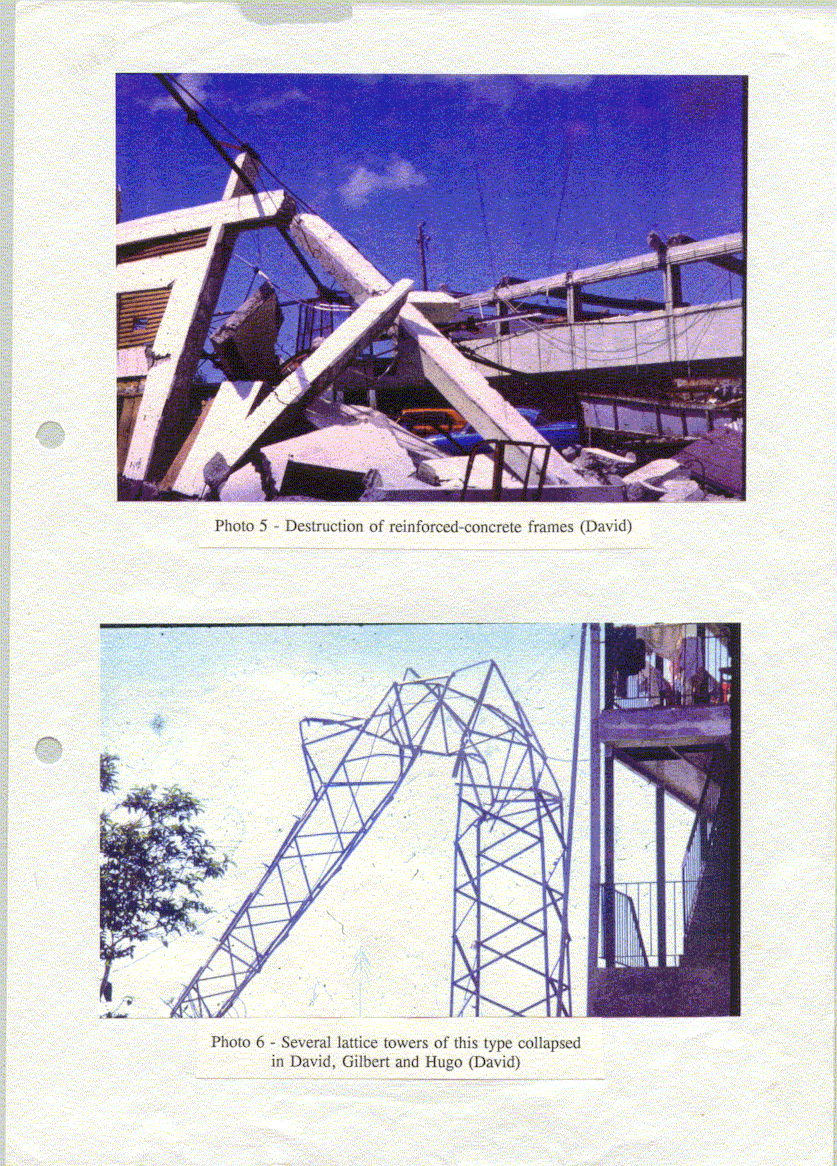
So this section on towers and masts suggest that in principle a design withstanding even the highest wind speeds would be possible to implement on those regions, but so far not too many firms/people/authorities cared about this resilience. Some SHF antennas (parabolic, offset or other designs) used for long distance connection either for horizontal (terrestrial) point to point connections or for a satellite link up/downlink have a problem since they have a high wind drag and the materials widely used aren't not thick enough to widthstand the high torque forces. They either bend or break which on both cases renders them useless and usually they can't be repaired. Some more research has to done on satellite dishes made from solid concrete and their 'survival rates' during tropical storms. They do exist, this author has seen some of them built by ham radio operators. They used this material because of the low costs and in order to be able to cast the dish according to their own specifications (like e.g. F/D ratio). A ground mounted satellite dish made of solid concrete should be able to absorb high winds and even impacts of smaller objects without to much damage.
Some examples of similar structures have been found: Acoustic mirror [Wikipedia]
The alternative for increasing the chances of 'dish survival' would be a protective cover. Either those giant 'golf balls' made of extremely strong reinforced plastics (because metals would block incoming/outgoing SHF signals) which could allow operation to continue even during a storm, or a metal cover, some kind of 'garage' which can house the dish safely during the storm. It would have the advantage to shield the disk also from projectile impact provided the steel or better titanium is thick enough.
Kevlar comes to mind, because it's used in modern bullet proof vests or how about adding a steel reinforced concrete layer at the back of a commercial carbon fibre satellite dish. Creativity and testing is needed.
National authorities should demand that vital communication infrastructure should be able to survive a set of dangers that can be expected in the area such an entity will be or was constructed.
Archives and historical records should be (re)checked for clues about quantity and magnitude of such catastrophic events in the past and new regulations should be of course as stringent as the worst case found on record or what scientists of various faculties believe are possible in the future. After such a area specific analysis it would also be easier to determine what option (A or B) to pursue.
The New Yorker's Amy Davidson, meanwhile, recalls Haiti's recent 7.0-magnitude earthquake, which was less powerful than Japan's but decimated the country's vulnerable infrastructure and killed hundreds of thousands of people. "The scenes from Japan are awful," she writes, but comparing the disasters in Japan and Haiti provides "evidence of why earthquakes are political and economic, almost as much as natural, experiences." Buildings in Tokyo swayed, other water-drenched structures collapsed, and cities in northern Japan suffered more than the capital, Davidson writes, but Tokyo "hasn’t been flattened in anything like the way Port au Prince was."source: Did Engineering Save Lives in the Japanese Earthquake? [The Atlantic, Mar 11 2011]
In a sign of Tokyo's reslience, images are now surfacing of the Tokyo Tower, re-lit and relatively unscathed.
source: Japan builds Tokyo Sky Tree, world's tallest tower [CNET, Mar 1 2012]
The Sky Tree's shinbashira is a hollow concrete tube housing elevators and stairs. It's structurally separate from the exterior truss but is joined by oil dampers, which help reduce quake shaking.
"The anti-quake measures in this structure can reduce quake vibrations by 50 percent," Hirotake Takanishi, PR manager for Tobu Tower Sky Tree, told me. "We've run simulations showing the Sky Tree will withstand an 8.0-magnitude earthquake, and can withstand even stronger ones, but we can't say definitely what its upper limit is."
B replacement hardware is safely stored nearby and doesn't need to be purchased from manufacturer once such an event happens. Ideally logistic experts like military has 24/7/365 access to such storage places in order to react fast enough. A storage place near a tactical airlift airport would be ideal.or
Reliable Hurricane prediction gives logistics/technicians at least 3 days time in advance to predict possible impact and to plan for effective approach to restore full, or at least partial, communication ability in order to reduce additional negative impact on the local population. Runways and properly working ports are important, but so is communication for multiple reasons.
Currently and in the near future earthquakes can't be predicted in advance.
Possible improvement rapid response
current conditions Sint Maarten:
engl.:"Situation on Sint Maarten is dire also due lack of basic needs andToestand op #SXM is grimmig. Mede door gebrek aan primaire levensbehoefte en communicatie. Daarom aankomende dagen opvoeren van capaciteiten— Koninklijke Marine (@kon_marine) September 9, 2017
communications. Thus in the upcoming days capacities will be increased."
Royal Dutch Navy
In order to avoid a delay caused by difficult conditions at one or more airports in the disaster area in coastal areas Navy vessels equipment with state of the art satellite communication abilities should also allow an optional microwave link from shore to ship and allow a 'bridge' function of on-board comms equipment with communication equipment deployed in the disaster zone. At least communication channels under the control of own troops should be able to establish a satellite link. If 'comms teams' are deployed before e.g. a hurricane hits the designated area they could use the time between they are safe to setup their gear and the time the Navy vessels are back in range of the microwave link after they have left the theater in order to avoid being affected by high winds and/or high seas. VHF/UHF link is also a possibility, which should be easier to establish, but has less usable bandwidth. In case of current island scenario it could have worked for local officials to use an emergency GSM network (restricted by special SIM cards or by phone IMEI numbers) including a direct link to the Netherlands or France.
Radio/TV
The full extend of damage to various Caribbean Islands is not know at this point and hurricane Jose trailing Irma has not left the area. According to preliminary reports some transmission towers not only carrying GSM cell phone signals but also those carrying radio and television signals have been knocked out by Irma and those which may have managed to survive the first blow might not endure a second beating by Jose. It should be considered to equip Navy vessels with some lower power FM transmitters for radio broadcasts and VHF/UHF transmitters for emergency TV channels usage.
Sans téléphone, sans internet, les rumeurs agravent les difficultés sécuritaires et matérielles. Attention aux rumeurs. #Prison #SaintMartin— Annick Girardin (@AnnickGirardin) September 9, 2017
Such low power transmitters (200W - a few KW) have been in use in the past at various Airforce and Army barracks where US, UK or other countries' forces have been stationed. A local population in a disaster zone with access to regular and reliable information might start to spread dangerous rumors and it is also useful to provide vital information in a time where there's a media blackout as well as a power blackout. Many locals have small radios or TV sets or at least have smart phones or tablets, but during a long lasting power blackout a free of charge distribution of e.g. simple solar chargers or the establishment of generator powered public recharging stations could be the first step to restore some control. Once the public has access to limit amounts of electricity they can use their devise to receive important messages such as planned evacuations or a constant flow of information that additional resources are being sent in. Larger Navy vessels like US carriers already have own TV studios and a CCTV system which just need to add a small transmitter."À cause du manque d'informations, les rumeurs les plus infondées circulent à Saint-Martin" https://t.co/dPxCt8JGgs pic.twitter.com/XVOiTY0Rot— LCI (@LCI) September 10, 2017
Regarding FM radio broadcasts it's also worth remembering that not only households have radios,but there also portable radios, those in in cars, and also many modern phones have built-in FM radios (often the headphone cables serve as an antenna). Regarding broadcasts from ship to shore, there's nothing unusual about it since this was done since the 1960s by various radio pirates which circumvented national broadcast legislationRadio d'urgence : les fréquences seront communiquées dès que possible dans la journée du 10 septembre ainsi que lien pour l'écoute en ligne https://t.co/YNaPqfw4nY— franceinfo (@franceinfo) September 10, 2017
in the UK : Radio Caroline
and in the NL : Radio Veronica
So the idea that Navy vessels should be able to broadcast in emergency situations isn't so far fetched at all. Especialy when keeping in mind that many larger population centers around the globe are near or directly located at the coast.Of course using FM band instead of long or medium wave (in AM) would make much more sense nowadays. If Navy vessels are also used for emergency assistance their role in 'rumor control' and informing the local population (with perhaps some entertainment as well) should be made possible by adding some broadcast equipment consisting of transmitter and a rotatable Yagi antennas .
source: WSJ , Sep 8 2017>>Speaking at the same news conference, Dutch Interior Minister Ronald Plasterk said that some 70% of the houses on St. Maarten have collapsed. After days of major difficulties in communicating with the island, “some communication” has now been restored, he said.Soldiers have distributed leaflets and used megaphones to tell locals to stay indoors, as Hurricane Jose is expected to pass north of the island later on Saturday. Most patients have been evacuated from the island, the minister said.<<
Although good old leaflets are better than no information at all, they also require some logistics to get printed and distributed. It might take some investments to be able to deliver 21st Century solutions to our vacationing citizens and locals alike, but once modern communication assets are in place it sure makes getting the 'official word' out much easier & faster. Many people have sophisticated hardware to receive such messages and are perhaps even more than willing to provide feedback to authorities in order to speed up and optimize rescue & relief efforts. Once the broken communication channels (radio/TV/GSM networks/WIFI) the citizens are familiar with are restored the mood will most likely change from 'grim' to 'a bit more relaxed'. Considering bandwidth scarcity during the initial phase, perhaps starting firing up GSM SMS messaging service and public WIFI with only a limited number of open ports for the use of messaging apps like Whatsapp, Twitter, Facebook would be sufficient. It would certainly send a positive message that the local, disaster struck society isn't warped back some fifty or more years when they have to cope without electricity and modern electronic communication for many days or even weeks.
Hurricane Irma was terrible, there's no question about it, but it has been mentioned back in 2015 in a blog post regarding the need of much better organized disaster response in case something really catastrophic with many thousands of deaths and widespread chaos happens. On the scale suggested in the earlier article, current emergency in the Caribbean area of our planet is perhaps a level 1 or 2 event. Much bigger earthquakes or tropical storms, or *god forbid* the impact of an asteroid, will happen some time in the future, so a much quicker and more focused response can actually save lives. We are lucky to have so many very useful gadgets - we only have to use them when we lose the vital infrastructure in a disaster event. Mass tourism to very remote areas of the planet also requires more preparedness to support, inform and if necessary also to extract our citizens from their vacation destinations. NATO has excellent logistical skills to handle the aftermath of such unfortunate, but inevitable events - just a few adjustments or upgrades needed in future.
Wireless radio and TV services are easier to provide than power which could be generated aboard the vessels, but thick cables are required to provide electricity for most important onshore buildings like e.g. hospitals/police stations/jails. Depending on the size of a Navy vessel maybe not a bad idea to have 1 or 2 smaller spare generators (conventional or solar/batt system) for such events on board.
planned future related blog releases:
Please note that a second blog post on (timely) evacuations of tourists especially from NATO countries using common NATO resources under a unified command is also 'in the pipeline'. Recent developments in the aftermath of hurricane Irma will be mentioned as well as conclusions from natural disasters which happened in the past.
(in order to fulfill that vital civil protection task for citizens living/vacationing abroad, defense spending in all NATO member countries must be brought back to 2% of GDP where this required minimum isn't currently met)
note: as always during an unfolding event it's highly likely that some additions will be added later to this blog post
related articles (multiple languages)
re TV:
Hurricane Irma legt tv- en radiozenders Sint Maarten plat [tvtotaal.nl, Sep 6 2017]
List of television stations in the Caribbean [Wikipedia]
Huisvesting [re NTSC system being used in Sint Maarten, www.vakantienaarsintmaarten.nl]
NTSC [Wikipedia]
re radio:
Broadcast 500W and 1KW FM Transmitters [commercial] #
#SaintMartin #SaintBarthelemy Urgence Info Îles du Nord émet en français, créole et anglais sur 91.1 à Saint-Martin https://t.co/04QdpJRhQ3 pic.twitter.com/uJVhB9PM0T— franceinfo (@franceinfo) September 10, 2017
#StMaarten: air evacs suspended for today. We continue to communicate w/ US citizens via social media, radio (101.1 FM) & phone w/ hotels.— Travel - State Dept (@TravelGov) September 10, 2017
US Citizens in #SaintMartin (French side): French police recommend continuing to use 101.1 FM on radio for English language instructions.— Travel - State Dept (@TravelGov) September 13, 2017
re Social media:The power of public radio. Great video of @wgcu in Fort Myers & how they kept people informed during Hurricane Irmahttps://t.co/P46mrdK0lP— Russell Lewis (@NPRrussell) September 11, 2017
How to use Twitter during a major catastrophe [EZR, May 2015]
How should governments respond to disasters in the digital age? @CBjola #Irma https://t.co/IRveaSYQIc— RUSI (@RUSI_org) September 11, 2017
re power storage systems:We provide #disasterrelief, storm clean up&health/wellness info on all our social media. Stay connected with us! https://t.co/Fexh75gR4b— Harris County PH (@hcphtx) September 11, 2017
for households:
Nissan geeft auto-accu's tweede leven in je meterkast [RTL Z, May 13th 2016]
Prevention strategies to limit impact of catastrophic events [EZRdevelop, Nov 2012]
Automatic link establishment
Subscribe to:
Posts (Atom)